

Growing a law firm takes more than good legal work. Your firm needs to be profitable, and to do that you need to attract new clients and generate new business. But if the right people can't find you, none of it matters.
A clear marketing plan makes that possible. With the right strategy in place, marketing becomes a repeatable way to bring in clients and grow your firm. In this guide, we’ll walk you through the key elements of a law firm marketing plan and how to build one that helps you reach your goals.
What Is a Law Firm Marketing Plan?
A law firm marketing plan is a structured document that outlines the specific actions, timelines, and resources needed to achieve business goals. It details measurable activities across defined channels and timeframes to attract and retain potential clients. This plan serves as a guide for executing and measuring performance across campaigns, teams, and priorities over a set period.
Marketing Plan vs. Marketing Strategy: What's the Difference?
These two terms are often used interchangeably, but they serve distinct purposes in law firm marketing. Understanding the difference helps teams stay aligned and execute more effectively.
Your marketing strategy is the high-level direction a business takes to achieve its long-term marketing goals. It focuses on the firm’s value proposition, brand identity, and target audience. It answers where you’re going and why.
In contrast, a marketing plan outlines the specific actions needed to execute the strategy and achieve your goals. It breaks down broad goals into campaigns, timelines, budgets, channels, and measurable objectives. It answers how you will get there.
How to Create a Law Firm Marketing Plan
Most law firms market reactively. They try something, hope it works, and move on when it doesn’t. A well-defined marketing plan changes that. It gives you a clear roadmap of who you’re targeting, how you’ll reach them, and how each strategy connects to your bigger goals.
Here's how to build yours in five simple steps.
1. Define Your Niche and Ideal Client
Before you spend a dollar on marketing, get clear on who you're trying to reach. The more specific you are, the easier it becomes to create messaging and campaigns that actually resonate with the right people.
Start by answering these questions:
- What legal services do you provide? List every practice area your firm currently handles.
- What do you want to be known for? You can't be known for everything. The more targeted your focus, the more you attract the right clients and build a reputation in a specific area.
- Who is your ideal client and why would they choose you? Think about their situation, what they need, and what would make them pick your firm over someone else.
Once you've answered those, build a client persona. A client persona is a detailed profile of your ideal client based on real patterns you've observed in your practice. It removes the guesswork from your marketing by helping you speak directly to the person most likely to hire you, rather than trying to appeal to everyone.
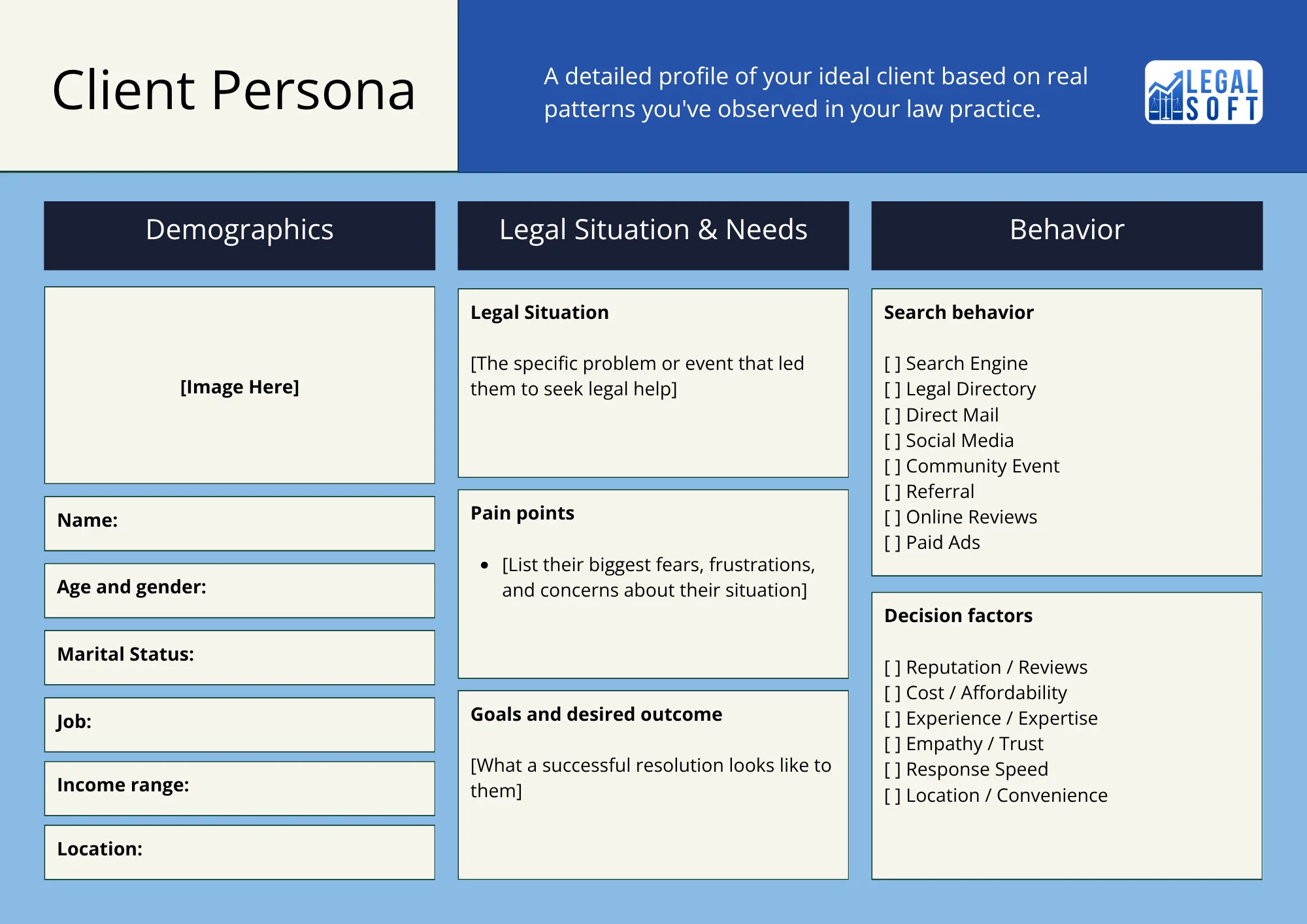
This profile becomes the foundation that every other step is built on. If you serve multiple practice areas, create a separate persona for each.
2. Identify Your Market and Competition
Once you know your niche, take a look at the landscape around you. Who else is serving your target clients, and what are they doing well or not so well?
Your positioning comes directly from this analysis. It answers one of the most important questions in your marketing: why should someone choose you over another attorney? Without a clear answer, every campaign you run will feel generic.
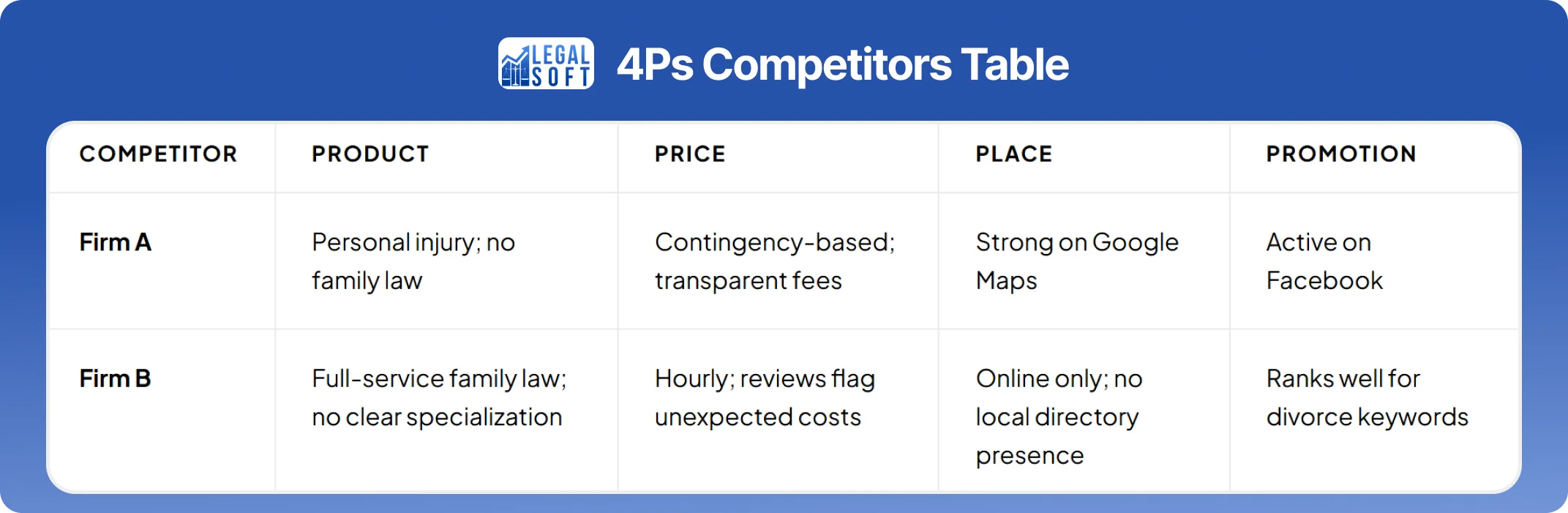
A practical way to analyze your competition is through the 4Ps of marketing, a concept developed at Harvard in the 1950s that still holds up today. To find each competitor's information, put yourself in the shoes of a potential client. Search for a law firm the way your ideal client would, then walk through the full experience of finding and reaching each competitor.
What you discover across these four areas tells you a lot:
- Product (Service): What legal services do they offer, and what problems do they solve? How does their offer compare to yours in terms of depth, specialization, or client experience?
- Price: What do they charge, and what fee model do they use (hourly, flat fee, or contingency)? Look at their reviews to see whether clients feel their fees are fair and transparent.
- Place: Where and how do clients access their services? Consider both their physical presence and online reach. Do they make it easy for clients to find and contact them?
- Promotion: How do they reach their audience? Look at SEO rankings, social media, paid ads, video content, and community involvement. Note which channels they focus on and which they ignore.
Here’s an example of a table you can create.
3. Set SMART Goals
Now that you understand your position in the market, you need specific goals to guide your marketing efforts. Vague goals like "get more clients" won't move the needle.
To be effective, your goals need to be Specific, Measurable, Actionable, Realistic, and Time-driven so you always know whether your plan is working. Break them into three timeframes with clear targets:
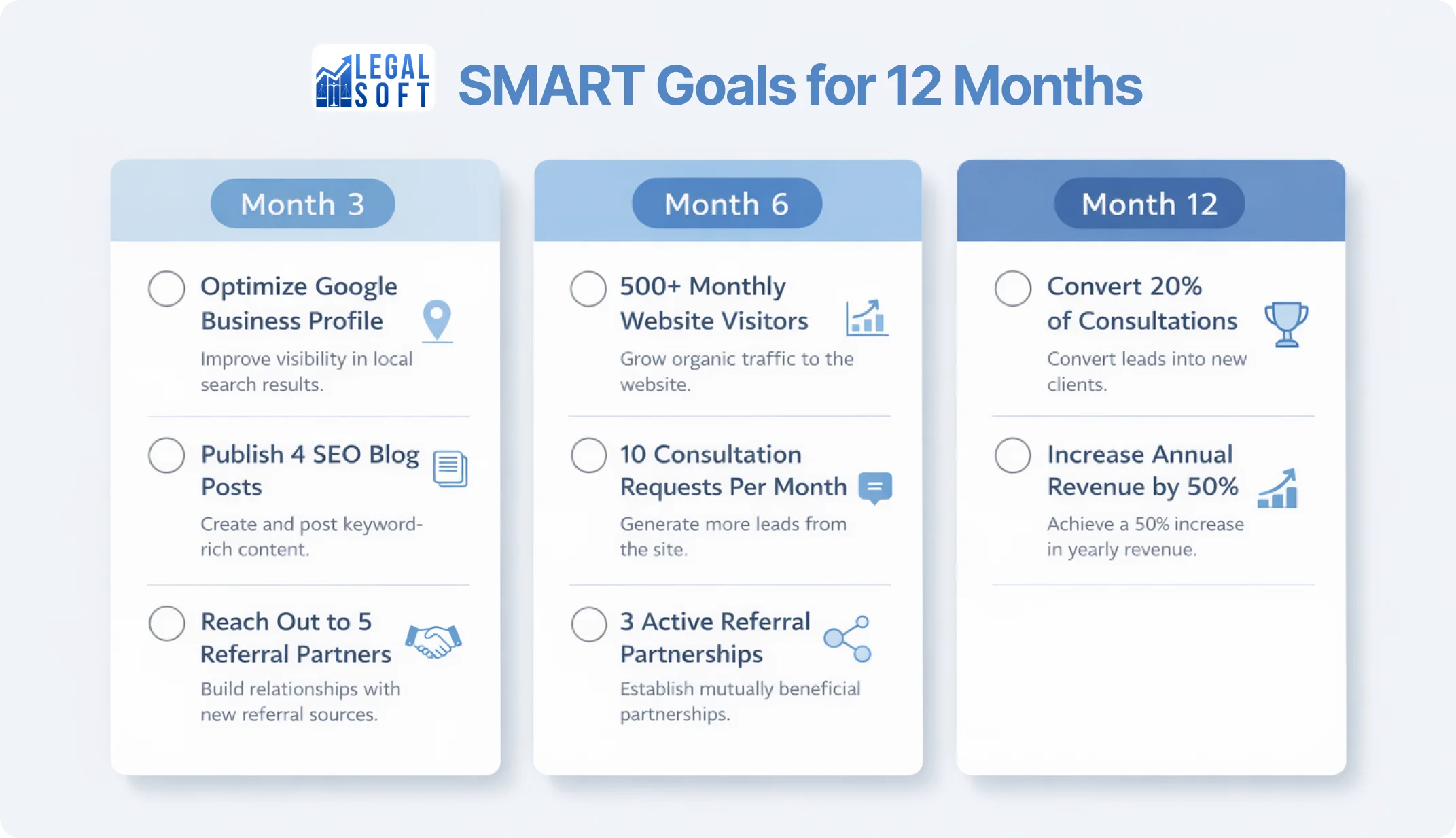
Put these goals on your calendar as actual appointments and share them with any staff involved in your marketing efforts
4. Choose and Execute Your Marketing Strategies
Now that you have the data, it’s time to take action. Based on your niche, audience, and goals, choose the marketing channels that make the most sense for your firm.
You don’t need to do everything at once. Start with two or three strategies you can execute consistently. These are not one-time tasks and need ongoing improvement as your competition continues to evolve.
When choosing your channels, consider these factors:
- Where your ideal clients spend time: Are they searching on Google, using social media, or attending local community events?
- Your current capacity: If you’re a solo attorney, be realistic about your time. If needed, consider working with a marketing agency or adding virtual marketing support.
- Investment: Some channels require tools and ongoing costs. Decide how much you’re willing to invest and for how long.
- Activity level: How active can you be? Spreading yourself too thin across many channels often leads to poor results. It’s better to focus on two strong channels and stay consistent.
- Measurement: How will you measure success? Define clear metrics for each channel so you can improve over time. For example, track organic traffic and conversions using tools like Google Analytics.
5. Set Your Budget and Compile the Plan
Marketing without a budget is just wishful thinking. Decide upfront what you're willing to invest in both time and money, and factor in your firm's overall financial commitments before allocating anything to marketing.
With your target client profile, goals, and chosen strategies already defined, you're in a better position to spend wisely. Assign a specific budget to each channel so your spending stays intentional and your return on investment is easier to track over time.
Once your budget is set, compile everything into a single document that includes:
- Your niche and target client profile
- 3, 6, and 12-month SMART goals
- Chosen marketing strategies and channels
- Monthly budget breakdown by channel
- How you'll track and measure results
Keep it somewhere visible and easy to access so you can review it regularly. This plan isn’t meant to be perfect from the start, but something you refine over time as you learn what works and what doesn’t.
Here is a sample law firm marketing plan template you can use to get started.
Law Firm Marketing Strategy Ideas
Once your positioning and fundamentals are clear, it’s time to implement tactics that work. Below is a breakdown of practical marketing ideas you can start implementing.
SEO (Search Engine Optimization)
Search engine optimization is the process for a law firm’s website to increase visibility on organic search engine results by ranking higher for queries. It means that when someone types "hire personal injury attorney," your website has a real shot at being the first result they see organically.

That visibility matters more than many firms realize. According to HubSpot's State of Marketing Report 2026, SEO continues to deliver one of the highest returns on investment among marketing channels. Unlike paid ads, the work you put into SEO today can continue generating leads months or even years later without ongoing ad spend.
To optimize your law firm’s website for search engines, focus on these key areas:
- Audit your website first. Before making changes, you need to understand where your website currently stands. A site audit helps uncover hidden issues such as broken links, slow load times, and duplicate content that can quietly prevent your site from ranking. Tools like Screaming Frog can help identify these problems and provide insight into how they can be fixed.
- On-page SEO. Each page on your website should target a clear keyword and include an optimized title tag, meta description, and well-structured headings. This helps search engines understand what the page is about while also making it easier for visitors to read and navigate.
- Optimize for mobile. Many potential clients will find your firm using their phones rather than a desktop computer. Your website needs a responsive layout that looks and functions well on any screen size. Google also ranks mobile-friendly sites higher, so this is both a user experience and an SEO requirement.
- Follow EEAT guidelines. One of the ways Google evaluates content for rankings is through a framework called Experience, Expertise, Authoritativeness, and Trustworthiness (E-E-A-T). Including attorney bios with credentials, citing credible sources, and publishing accurate, up-to-date content all help strengthen your site’s E-E-A-T signals.
- Local SEO. If your firm serves clients in a specific city or region, local SEO helps your practice appear in location-based searches. This includes fully optimizing your Google Business Profile, keeping your name, address, and phone number consistent across directories, and targeting location-specific keywords.
AI Search Optimization
AI search tools like ChatGPT, Google AI Overviews, and Claude are changing how people find legal help. According to Google's Think with Google research, queries in AI Mode experiences are becoming longer and more complex. This means a potential client can go from asking a complex legal question to choosing an attorney in a single session.
The exact ranking signals AI platforms use aren't publicly disclosed, and they differ across tools. But, firms that are most likely to be recommended tend to share a few key traits:
- Clear expertise signals and well-structured content
- Direct answers to the questions potential clients are asking
- Brand mentions from trusted third-party sources like legal directories, news outlets, and professional organizations
To improve your visibility in AI search, focus on publishing content that directly answers potential clients questions. At the same time, build credibility by earning mentions from trusted websites, including legal directories, news outlets, and professional organizations.
Paid Search Advertising
Search ads allow law firms to appear at the top of search engine results pages by bidding on keywords and paying when someone clicks on the ad. Because of this immediate visibility, they often generate inquiries much faster than relying on organic search alone.
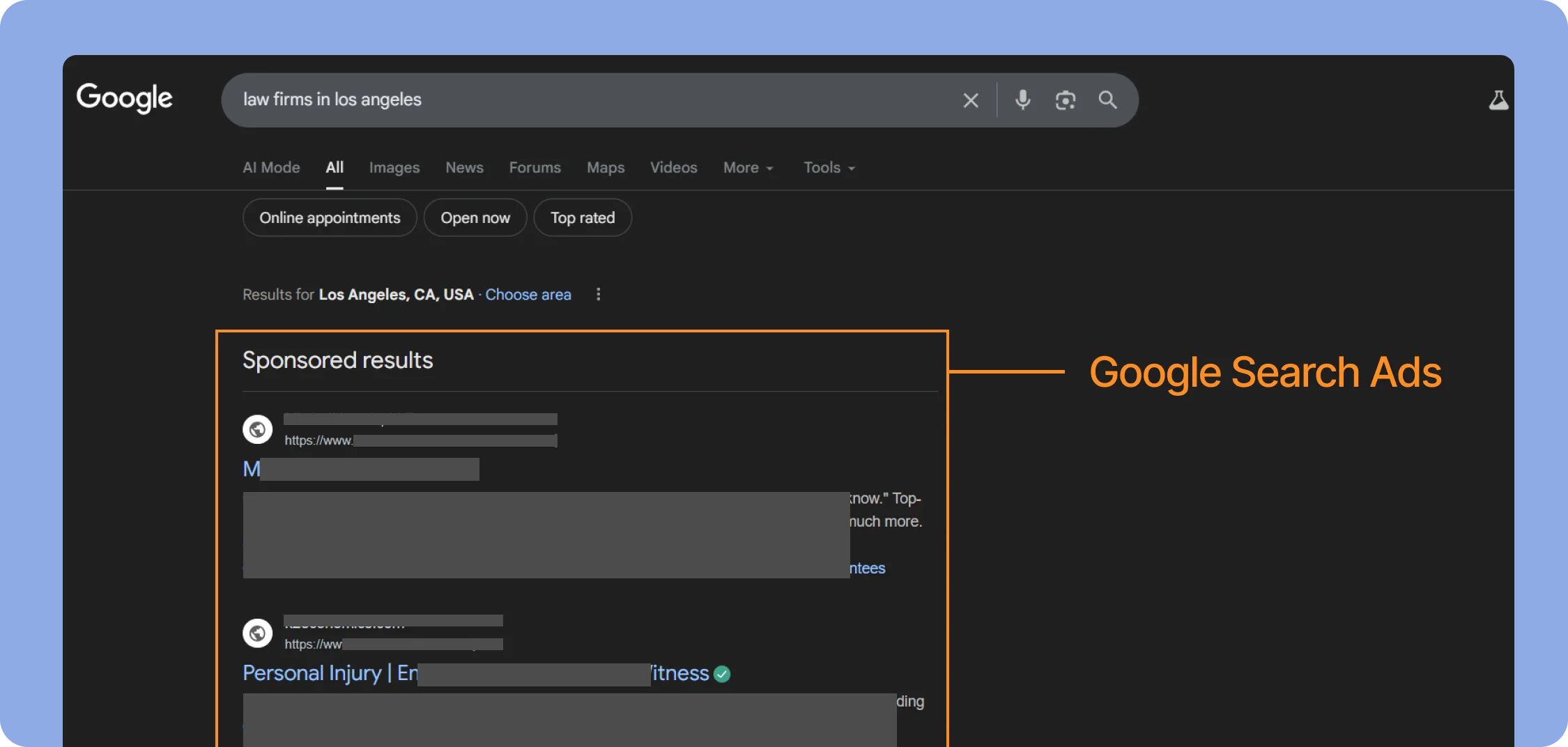
To run search ad campaigns effectively:
- Geotarget precisely: Restrict ads to relevant cities or zip codes to avoid wasting budget on searches outside your service area.
- Start small: Start with a modest daily budget to test performance and prevent overspending, then scale campaigns that prove profitable..
- Track everything: Monitor which keywords generate leads, calculate cost per lead, and use A/B testing on ad copy and landing pages to improve results over time.
Social Media Marketing
Social media helps law firms build trust and stay visible to potential clients. You don’t need to be everywhere to make it work, focus on the right platforms and you can:
- Expand your professional network. LinkedIn is the most widely used social platform among law firms, according to the ABA's 2023 Tech Report. It is built for professional credibility, making it the strongest channel for referrals and showcasing your firm's expertise.
- Reach a broader audience. Platforms like Facebook and Instagram give firms access to large local audiences, helping you stay visible to potential clients who may come across your content in their feed.
- Build community and trust over time. Consistent, helpful content positions your firm as a reliable resource. When people are ready to hire an attorney, they are more likely to choose firms they’ve seen regularly.
Here’s a simple social media guide to get started:
Consistency matters more than volume. One quality post per week on the right platform beats daily posting without clear strategy.
Law Firm Website
Your website is one of the first places clients learn about your firm. According to FindLaw’s 2023 Legal Needs Survey, over 75% of clients visit two to five law firm websites before contacting any one of them. The goal is not just to get visits, but to keep visitors engaged and guide them to take action without leaving to check other firms.
To make your website effective, focus on these key areas:
- Mobile responsiveness: According to Statista’s Mobile Internet Traffic over 60% of searches now come from mobile devices. Your site should use a responsive, mobile-first design, as mobile performance also affects Google’s Core Web Vitals and search rankings.
- Ease of use: Fast load times are critical, as slow websites cause visitors to leave. Your site should be easy to navigate, with clear structure, readable content, and helpful visuals that improve the user experience. To check your page speed, you can use Google’s PageSpeed Insights by simply pasting your page URL.
- Content: Create dedicated pages for each practice area or service, optimized with relevant keywords and clear, user-friendly copy. Each page should explain the service and you can include an FAQ section to answer common questions.
- Lead capture: Your website should clearly guide visitors toward taking action. Use clear calls-to-action, intake forms, and live chat for after-hours inquiries. Set up basic analytics and conversion tracking so you can measure performance and improve over time.
- Trust and Compliance: Build credibility with real trust signals such as client testimonials and anonymized case results. Keep your privacy policy updated and avoid making unverifiable promises.
Law Firm Branding
Your firm needs a clear and consistent brand identity. Branding is what makes your firm recognizable and memorable across every touchpoint.
In a crowded legal market, effective branding sets you apart from other firms. It communicates who you are, who you serve, and why someone should trust you before they ever speak with your team.
To build a strong brand, define the following:
- Visual identity: Your logo, color palette, typography, and imagery are some of the most visible representations of your brand, so they should be consistent across every platform. They should reflect your firm’s professionalism and the type of clients you want to attract.
- Brand voice and tone: Decide how your firm communicates. Are you formal and authoritative, or approachable and plain-spoken? Your voice should match your ideal client and stay consistent across your website, content, and social media.
- Value Proposition: Clearly define what makes you different. This should serve as the foundation of your brand messaging and communicate a specific experience that competitors don’t offer.
Once your brand is defined, your marketing becomes easier to execute and easier for potential clients to recognize. For more guidance, see our law firm branding strategies guide.
Reputation Management
A firm’s online reputation often serves as the first impression for prospective clients searching for legal help. Reviews, ratings, and testimonials provide social proof that helps people assess whether a law firm is reliable and capable of handling their legal needs.
According to the Local Consumer Review Survey 2026, 97% of consumers read online reviews before making a decision. Since most law firms serve local communities, reviews on platforms like Google, Yelp, and legal directories such as Avvo or Justia often can influence whether someone chooses to contact your firm.
To manage your reputation effectively:

- Request reviews proactively: Ask satisfied clients to leave reviews on Google and legal directories like Avvo.
- Respond professionally: How you handle criticism publicly shows professionalism and builds trust with potential clients.
- Showcase testimonials: Highlight client reviews on your website and social profiles to reinforce credibility at every touchpoint.
Video Marketing
Video content allows attorneys to explain complex legal topics in a format that's easier to understand and more memorable than written content alone. FindLaw’s 2024 U.S. Consumer Legal Needs Survey shows that 1 in 6 people who search for legal information online look for video content, suggesting that many prefer watching videos to better understand their situation.
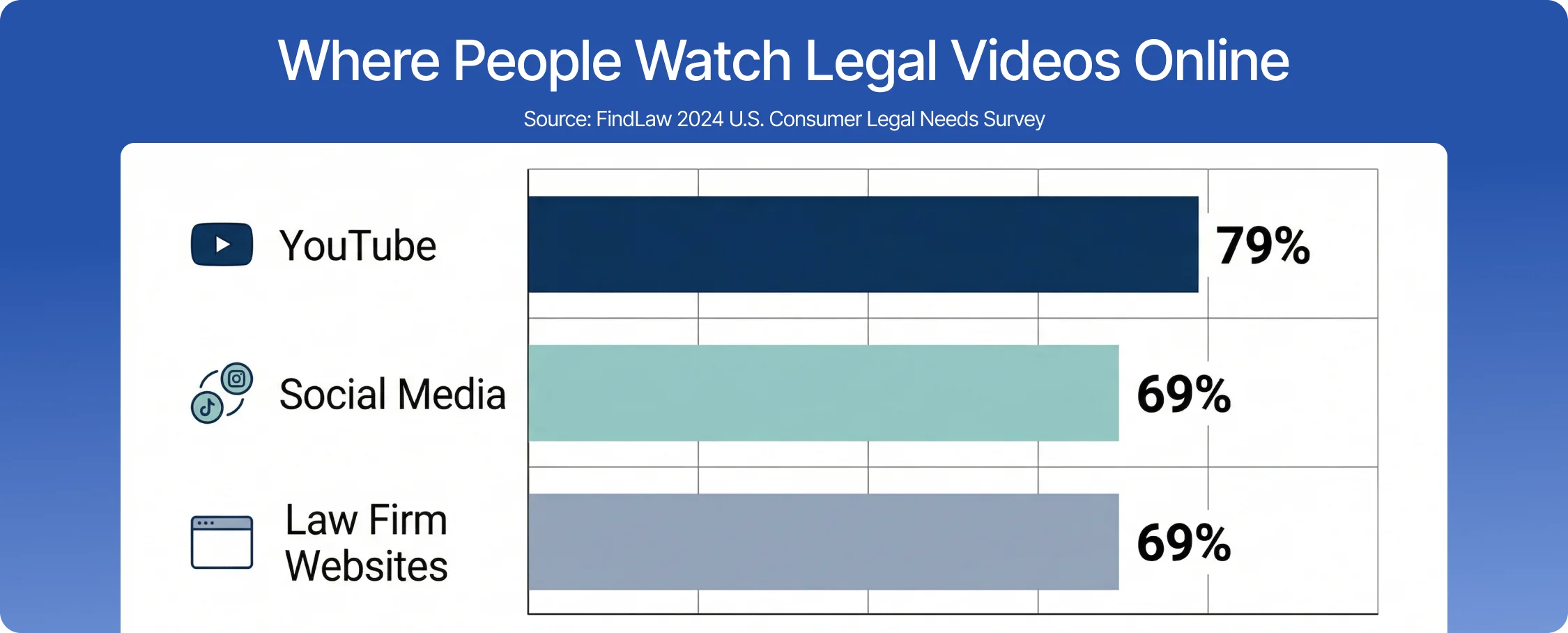
For law firms, this presents an opportunity to reach potential clients by providing helpful, easy-to-understand video content that answers common legal questions.
- FAQ and explainer videos: Short clips that answer common client questions. For example, a personal injury lawyer may explain “What to do after a car accident.”
- Attorney introductions: A brief video about your background and approach helps your firm feel more approachable before a client reaches out.
- Legal updates: Short videos covering recent law changes or common misconceptions help keep your audience informed and position you as a credible source.
- Hosting webinars: Live or recorded sessions on specific legal topics give potential clients and other legal professionals a chance to engage directly with your firm.
These videos make it easier for viewers to understand legal processes, remember key information, and feel more connected to your firm.
Email Marketing
Email marketing is one of the most cost-effective channels for law firms. A targeted email list lets you nurture leads, share useful information, and stay top of mind with people who may need legal services in the future.
An effective use of an email marketing strategy typically includes:
- Monthly newsletters: Share useful content such as legal tips, law updates, FAQs, and firm news relevant to your practice areas to keep subscribers engaged.
- Segmented lists: Not all subscribers have the same needs. Group your contacts so you can send more relevant and personalized messages.
- Consistent cadence: Sending emails monthly or bi-monthly helps you stay visible without overwhelming your audience.
Email also works well alongside content marketing. You can repurpose your best blog posts into newsletters to get more value from your content, and add a newsletter signup option on your website to grow your audience over time.
Local Networking Events
Face-to-face networking remains an important strategy for building professional relationships and generating referrals. Research in the European Research Studies Journal shows that strong professional networks are a key driver of long-term business relationships in service-based fields like law.
Focus your time on events where your ideal clients or referral sources are most likely to be:
- Chamber of Commerce meetings: Good way to connect with local business owners who may need legal services or refer clients.
- Local business events: Opportunities to meet entrepreneurs and small business owners, which can lead to new clients or partnerships with people who regularly interact with those needing legal help.
- Legal seminars and conferences: Help you stay updated on legal developments while expanding your professional network.
Consistent participation in these events increases your visibility within the local professional community. Over time, this visibility helps position you as a trusted authority in your practice area.
Referral Partnerships
Referrals often convert at a higher rate than almost any other lead source because they come with built-in trust. According to the Nielsen Global Trust in Advertising Report, 92% of consumers trust recommendations from people they know more than any other form of advertising.
Building referral partnerships with professionals who regularly interact with individuals needing legal services can create mutually beneficial relationships. These partners may include accountants, real estate agents, medical providers, or other attorneys whose clients may also require legal guidance.
Referral partnerships take time to develop, but they often become a steady source of qualified leads over time.
How to Measure Marketing Performance
A marketing plan only works if you know whether it’s actually delivering results. Tracking your performance shows what’s working, what’s wasting budget, and where to focus next.
Each channel measures success differently, so it’s important to track the key performance indicators (KPIs) that align with your goals. With clear data, you can make better decisions and get more value from your time and resources.
Here’s an overview of key aspects to measure:
Regularly reviewing these key metrics lets you adjust tactics and invest where it matters most.

Why Is Law Firm Marketing Important?
Marketing connects your legal expertise with the people who need it. Without a clear strategy for visibility, even the most skilled attorneys can struggle to generate new clients.
In fact, according to a study by IAALS at the University of Denver and HiiL, the internet is the first place people in the U.S. turn to when trying to understand a legal issue. If your firm isn’t visible at that moment or your messaging isn’t clear, potential clients may choose a competitor instead.
Effective marketing helps your firm show up at the right time for the right people who need your services. It allows you to:
- Attract ideal clients: Connect with people whose legal needs match your expertise.
- Strengthen credibility: Position your firm as professional and trustworthy.
- Generate results across channels: Use multiple channels to bring in new matters.
- Grow in a competitive market: Firms that market effectively gain visibility and trust that others don’t.
Without a marketing plan, effort gets scattered across channels that don't convert and content that doesn't reach the right audience.
Final Notes
Good marketing is not about doing everything at once. It is about knowing your clients, showing up consistently, and improving based on what the data tells you.
Start with the strategies that fit your firm’s capacity, execute them well, and build from there. Over time, every blog post, social update, email, and networking effort adds up. Firms that stay consistent are the ones that grow.
If you’re ready to move faster and attract new clients, Legal Soft provides virtual legal marketing assistants who work exclusively for your firm. They become a direct part of your team, helping manage and execute your marketing efforts across channels.
Frequently Asked Questions
What is the best advertising form for law firms?
The most effective option depends on your practice area, budget, competition, and target audience. Paid search ads and SEO often deliver strong results because people are actively searching for legal help when they see them. When paired with a well-optimized website, they create a solid foundation. Start with two or three channels you can manage and track well before expanding.
How do law firms market themselves?
Most law firms use a mix of online and offline strategies to attract new clients. This includes their website, SEO, social media, referral networks, and paid ads. Firms that see the best results focus on a clear niche and use multiple channels that work together.
What does marketing look like for a small law firm?
Small firms often benefit from focusing on low-cost channels that can still deliver strong results. A well-optimized website and a strong Google Business Profile (GBP) are a good place to start. Claim and optimize your GBP, ask satisfied clients for reviews, and make sure your website clearly explains what you do and who you help. As your budget grows, you can expand into local SEO to target relevant keywords in your area and improve your visibility in local search results.