

How do you protect your reputation as a law firm? Clients often come to lawyers during stressful or urgent situations. Before they decide to contact your firm, they want to know if they can trust you. A strong reputation helps shape that decision.
Law firm public relations is how you shape what people think about your firm before they ever meet you. It forms the first impression people have of your practice, from how you appear in the media to how your firm communicates with the public.
Whether you want to improve your reputation or develop a stronger strategy around it, this guide will walk you through law firm public relations and how it can support the growth of your practice. Let's start by defining what it means.
What is Law Firm Public Relations?
Law firm public relations is the strategic management of communication between a legal practice and the public. It shapes how a law firm is perceived through channels such as press releases, published articles, media coverage, and community involvement. Its main objective is to build the firm’s reputation, strengthen credibility, and create trust with the public.
Why Public Relations Matters for Law Firms
In 2026, there were roughly 418,000 law firms operating in the United States, according to IBISWorld. With so many firms and attorneys competing for attention, getting noticed and trusted takes more than good legal work.
Your firm may be winning cases, recognizing employees, or contributing to the community. But if people do not know about it, turning that work into a stronger reputation and more client interest can be difficult.
Law firm public relations gives your firm a way to stand out for the right reasons. Here are some of the main benefits of PR for law firms:
- Establish thought leadership: Publishing insights and commenting on legal developments positions you as an authority people turn to for answers.
- Increase brand awareness: Consistent media presence keeps your firm's name familiar to the people who may need you.
- Build trust and credibility: Earned coverage and recognition signal that respected outsiders vouch for your expertise.
- Attract potential clients: When people repeatedly see your firm cited as a credible source, reaching out can feel like a safer and more natural choice.
- Strengthen firm reputation: A proactive law firm public relations strategy helps protect your practice against negative perceptions and gives you a stronger foundation during potential crises.
- Support referral generation: A respected public profile can give other attorneys, past clients, and professional contacts more reasons to refer business to your firm.
Done well, the benefits of PR can compound over time. The more credibility your firm earns, the easier it becomes to support other parts of your growth.
Core Components of PR for Law Firms

Effective law firm public relations runs on several moving parts working together. Understanding these components helps you create coordinated efforts that support each other and form a consistent public presence.
Here are the main ways law firms can use public relations:
Media relations
This is the work of developing and keeping relationships with journalists, editors, and producers. When reporters need a legal expert, you want your attorneys to be the name they reach for. Strong media relations earn your firm coverage and position your attorneys as go-to sources.
Thought leadership
Sharing expert perspectives through articles, webinars, interviews, and speaking engagements demonstrates your knowledge in specific areas. Over time, it can turn your attorneys into recognized voices in their field.
Crisis communication
This is your plan for protecting your firm’s reputation when something goes wrong. It covers how you respond to negative press, client disputes, or public scrutiny. Having a clear plan in place before anything happens lets you respond quickly and protect your reputation when the stakes are highest.
Community and industry engagement
Visible participation through speaking at events, hosting webinars, and supporting causes raises your profile. It creates goodwill for your firm and expands your network. Relationships formed here often turn into referrals and opportunities later.
Content and publishing
Publishing blogs, newsletters, and reports gives you a channel to educate audiences and showcase expertise on your own terms. Consistent publishing also fuels your other PR efforts with material and creates new visibility.
Public Relations Channels Available to Law Firms

Law firm public relations can be distributed across many channels. The right mix depends on who you want to reach and what you want your PR efforts to achieve.
- Traditional media: Newspapers, magazines, radio, and television still carry weight and can add strong credibility. A feature or quote in a respected outlet can reach a broad audience and show that an independent source considers your firm worth covering.
- Digital and online publications: Legal news sites, industry blogs, and online magazines can help you reach more targeted readers. These outlets often welcome expert commentary, bylined articles, and legal insights, making them a useful channel for thought leadership.
- Social media: Platforms like LinkedIn let you share insights and engage directly with peers and prospects. They give your firm a human voice and steady visibility.
- Podcasts and webinars: Audio and video formats let attorneys explain complex topics in plain terms and position themselves as accessible experts.
- Owned media: Your website, blog, and email newsletters are channels you fully control. You decide the message, tone, timing, and topics, which makes owned media the foundation other PR efforts rely on.
- Legal directories: Chambers, Legal 500, and similar platforms. Many corporate clients and general counsel start their search here, so a strong listing has direct commercial value.
Determine What Type of PR Your Law Firm Needs
There's no single right approach to law firm public relations. The right program depends on who the firm serves and how it grows.
Work through these questions to find your direction.
- What are you trying to achieve? Decide whether your priority is gaining more visibility, attracting clients, or repairing a reputation.
- Who is your audience? Pin down who you most want to reach, whether that is individual clients, businesses, or referral sources.
- Where does your reputation stand now? Look at how your firm appears online and in the press so you know what you are working with or repairing.
- What resources can you commit? Be honest about the time, budget, and internal skills you can commit to PR efforts.
- What's your timeline? Some goals, like crisis response, are urgent, while others, like thought leadership, develop over months. Decide how much you can commit and how long before you expect to see movement.
Once you have answers to these, the right type of law firm public relations becomes much clearer. You can then choose tactics that fit your situation instead of chasing every opportunity.
Crisis management and reputation protection for law firms
There is no guarantee that a crisis can be avoided entirely. Even if you reduce every risk you can think of, there is still a chance you will face one, especially since law firms carry reputational risk that most businesses do not. It might be a lost high-profile case, a client dispute, a negative review that spreads, or an internal issue that becomes public.
But this does not have to be a constant worry if you have a plan ready. The most important part is how you respond and handle the situation when it arrives. The goal is not to spin the truth but to respond honestly and in a way that limits damage.
Here’s how to protect your reputation when it counts:
- Prepare before you need to. Decide in advance who speaks for the firm, how decisions get approved, and how fast you aim to respond. When pressure is high, a clear plan keeps you from reacting badly.
- Respond quickly but carefully. Silence often reads as guilt, while a rushed statement can make things worse. Acknowledge the situation promptly, then share details once you have the facts.
- Monitor what's being said. Use media and social listening tools to catch issues while they’re small. Problems caught early are almost always cheaper and easier to contain.
- Mind your ethical obligations. Attorney confidentiality and advertising rules still apply in a crisis. Coordinate any public response with an eye on your professional and ethical duties, because what you cannot say is sometimes as important as what you can.
- Repair and rebuild afterward. Once the immediate threat passes, focus on restoring trust through consistent, positive communication. A well-handled crisis can even strengthen your reputation if you respond with integrity.
The firms that come through a crisis intact are usually the ones that prepared for it when nothing was wrong.
How to Measure the Success of Law Firm Public Relations
Law firm public relations is harder to measure than paid advertising, but it’s not impossible to track. You don’t need to measure every single impression or metric out there. Focus on specific metrics that connect to your goals instead of relying only on vanity numbers.
Here's what to keep an eye on:
The metric that matters most is new business, so connect law firm public relations activity back to intake whenever you can. A simple way to do this is to ask every new client how they found you and record the answer.
Should You Hire a Law Firm PR Agency?
At some point, your firm may need to choose between hiring outside help and handling public relations internally. Both options can work, but the right choice depends on your budget, internal capacity, and how much specialized media access your firm needs.
Benefits of Hiring an Agency
- Industry expertise. Specialized agencies understand the legal field and the rules that govern attorney advertising and ethics.
- Media relationships. Established agencies often have existing relationships with legal and business journalists that would take a firm years to develop alone.
- Capacity and consistency. An agency keeps your program moving even when your team is buried in casework.
- Outside perspective. An external partner can spot opportunities, risks, and story angles that may be harder to see from inside the firm.
When In-House PR Makes Sense
- Deep firm knowledge. Internal staff already understand your culture, attorneys, and clients without a long learning curve.
- More control. Your firm can set priorities, approve messaging, and manage communication directly.
- Cost efficiency. For smaller firms with a limited budget or modest PR needs, handling PR internally can cost less than hiring an agency on retainer.
- Existing capacity. Your firm may already have a marketing or communications person who can take it on.
Best Practices for Law Firm Public Relations
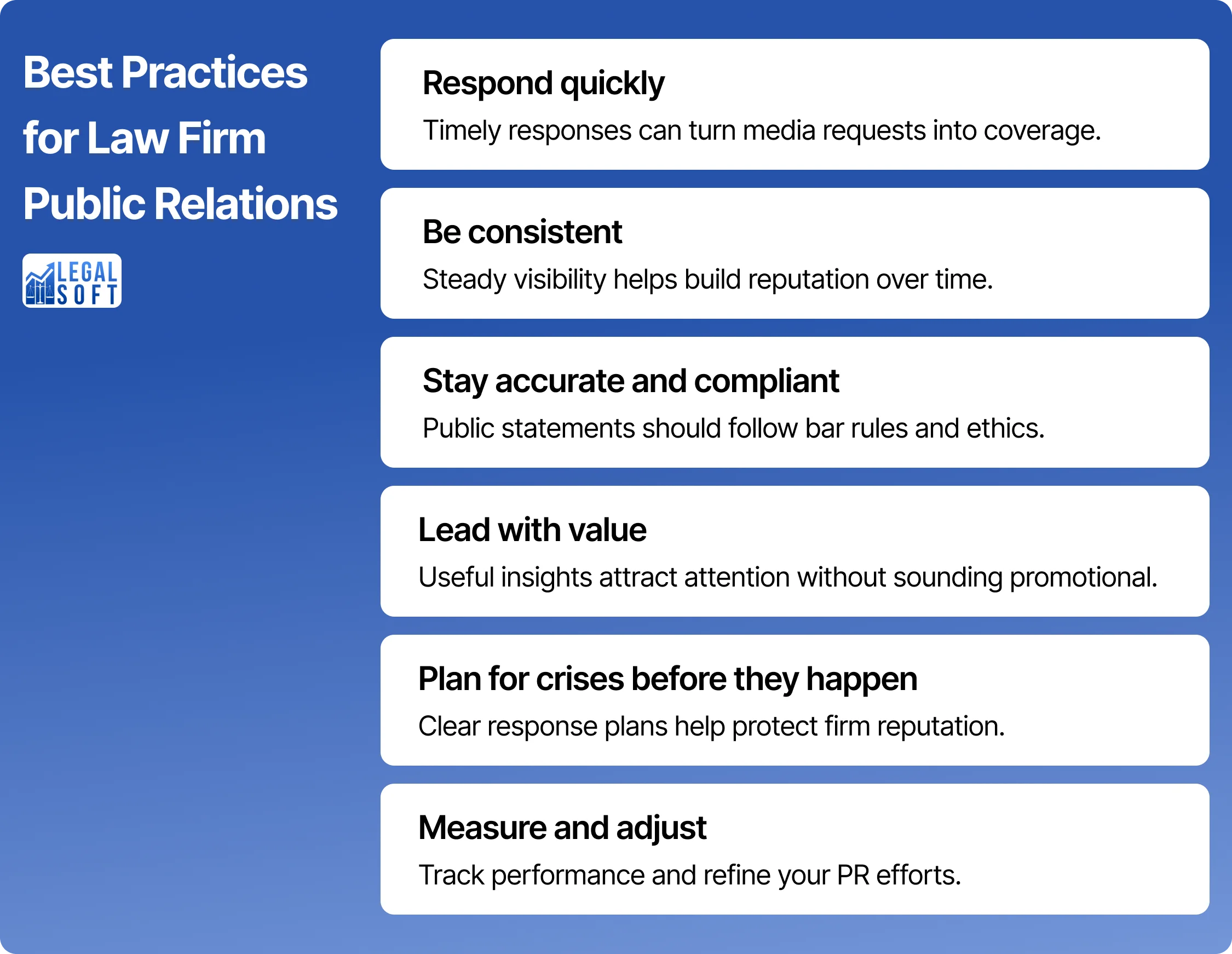
A few habits separate firms that get results from those that waste money. Keep these in mind as you build your program.
- Respond quickly. News cycles move fast, and journalists often work on tight deadlines. Responding fast to a media request can turn into valuable coverage.
- Be consistent. A reputation takes time to earn, so steady effort beats occasional bursts of activity. A reliable public presence can compound in your favor over time.
- Stay accurate and compliant. Bar rules govern what lawyers can claim publicly. Never overstate results, and review public statements for compliance before they go out.
- Lead with value. Share useful insights instead of focusing on self-promotion. Helpful content gives people a reason to pay attention to your firm.
- Plan for crises before they happen. Decide who speaks for the firm, what the approval process looks like, and how quickly your team should respond.
- Measure and adjust. Track what works and shift your resources accordingly. Law firm public relations improves when you treat it as an ongoing practice, not a one-time push.
Final Thoughts
Law firm public relations is a practical tool any firm can use to earn trust and build credibility. The firms that invest in it set themselves up for a stronger reputation. PR rewards those that show up consistently and can back their claims with real results.
Reputation is too important to leave to chance. Whether you run a program in-house or hire an agency, put it in the hands of people who understand the legal field and your firm goals. What matters most is starting with a clear strategy and staying consistent with it.
Manage your reputation with the right professionals
If you're ready to take your firm's reputation seriously, the right support makes all the difference. At Legal Soft, we provide law firms with experienced marketing assistants who focus exclusively on the legal industry. They become a dedicated extension of your practice, managing your law firm public relations and broader marketing efforts.
Frequently Asked Questions
Can solo attorneys do PR?
Yes. Solo attorneys can run effective PR through thought leadership, media commentary, and content. You don't need a large campaign to begin. By focusing on a niche or narrow practice area, you can become a recognized voice over time.
What are the benefits of public relations for a small law firm?
Law firm public relations helps a small firm compete with larger firms by building credibility and local authority. Steady visibility and earned coverage can make the firm easier to recognize and can shape public perception organically without relying only on paid advertising.
What is the difference between public relations and law firm marketing?
Public relations focuses on earning reputation and credibility through third-party validation such as media coverage, thought leadership, and community engagement. It's mainly about influencing how others perceive your firm.
Marketing focuses on directly promoting a firm's services to attract and generate clients, using strategies such as paid advertising, websites, SEO, and email campaigns. It's primarily about driving conversions like consultations or calls.
The two overlap and work best together. Law firm public relations earns the trust that makes marketing efforts more effective, while marketing turns that trust into concrete business.
Can public relations help lawyers get more clients?
Yes, though it usually works as part of a longer-term strategy rather than an instant result. Law firm public relations creates the visibility and credibility that make people more likely to choose you when they need legal help.