
Bar Reciprocity by State
Bar reciprocity is a process that allows eligible attorneys licensed in one U.S. jurisdiction to be admitted in another without taking that jurisdiction’s bar exam. There’s no single set of bar reciprocity rules that applies nationwide. Eligibility depends on where you’re currently licensed and the admission rules of the jurisdiction where you want to practice.
Most jurisdictions consider factors such as years of active legal practice, good standing in jurisdictions where the attorney is admitted, and a character and fitness review. Use the Bar Reciprocity Checker below to see whether admission on motion is available for your route and what other admission pathways may apply.
Bar Reciprocity Checker
Select the state where you're currently licensed and the state where you want to practice to see whether admission on motion may be available between them.
General information, not legal advice. Admission rules and requirements change frequently. Confirm every result with the destination jurisdiction's bar admission authority before starting your application.
Quick Note: States Without Admission on Motion
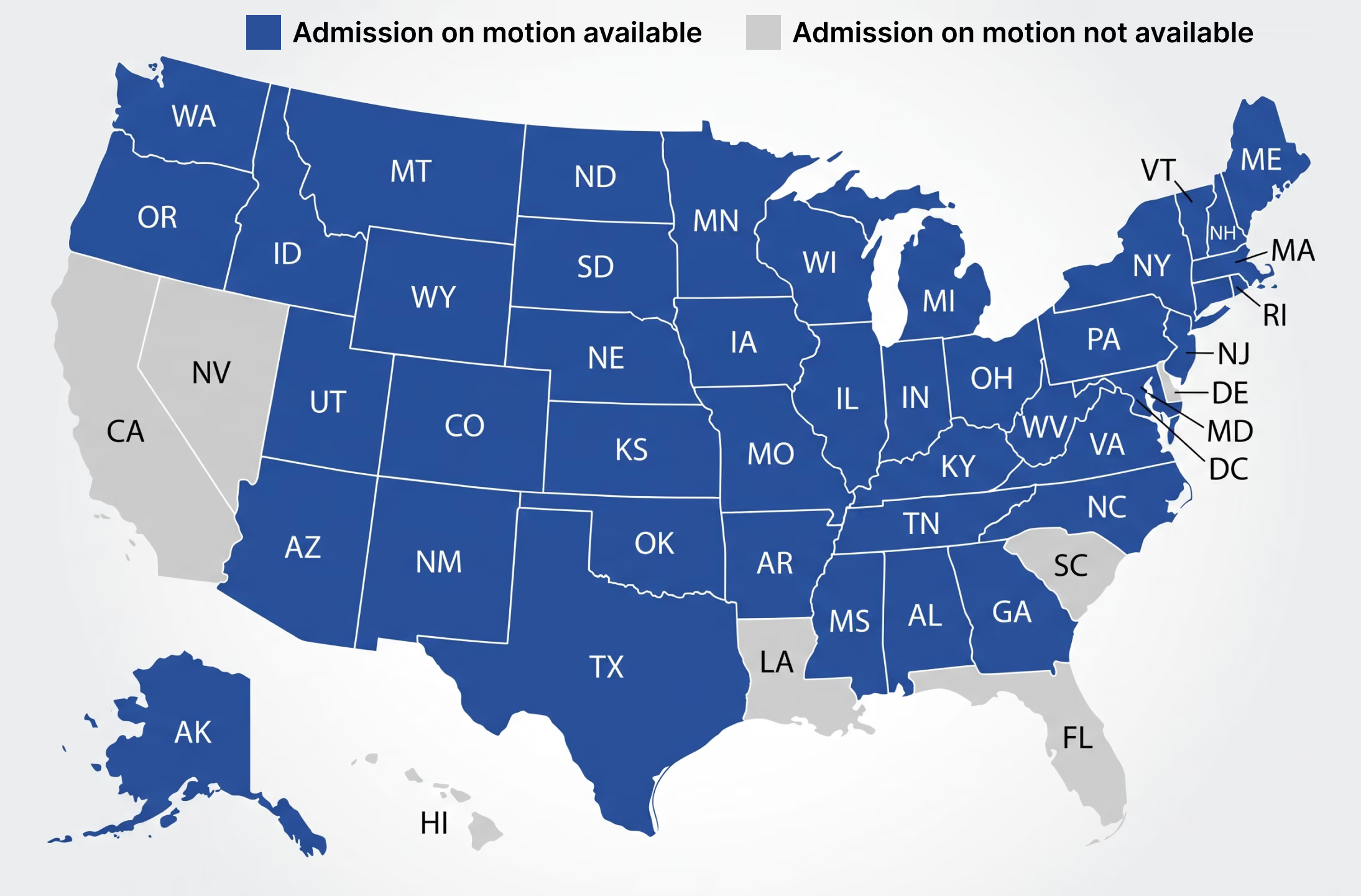
Eight states don’t offer a general admission-on-motion pathway. Attorneys seeking admission in these states must use another available pathway, which in most cases means passing that state’s bar exam.
- California
- Delaware
- Florida
- Louisiana
- Nevada
- Rhode Island
- Hawaii (limited to University of Hawaii law faculty, active-duty judge advocates, and attorneys at qualifying legal aid providers)
- South Carolina (limited to the dean or a tenured professor at the University of South Carolina School of Law or the Charleston School of Law)
Bar Reciprocity by State
The list below shows where attorneys may qualify for admission on motion based on the jurisdiction where they’re currently licensed.
| Licensed in | Admission on motion |
May transfer to |
|---|---|---|
Alabama | Yes | |
Alaska | Yes | |
Arizona | Yes | |
Arkansas | Yes | |
California | No | |
Colorado | Yes | |
Connecticut | Yes | |
Delaware | No | |
District of Columbia | Yes | |
Florida | No | |
Georgia | Yes | |
Hawaii | No (limited) | |
Idaho | Yes | |
Illinois | Yes | |
Indiana | Yes | |
Iowa | Yes | |
Kansas | Yes | |
Kentucky | Yes | |
Louisiana | No | |
Maine | Yes | |
Maryland | Yes | |
Massachusetts | Yes | |
Michigan | Yes | |
Minnesota | Yes | |
Mississippi | Yes | |
Missouri | Yes | |
Montana | Yes | |
Nebraska | Yes | |
Nevada | No | |
New Hampshire | Yes | |
New Jersey | Yes | |
New Mexico | Yes | |
New York | Yes | |
North Carolina | Yes | |
North Dakota | Yes | |
Ohio | Yes | |
Oklahoma | Yes | |
Oregon | Yes | |
Pennsylvania | Yes | |
Rhode Island | No | |
South Carolina | No (limited) | |
South Dakota | Yes | |
Tennessee | Yes | |
Texas | Yes | |
Utah | Yes | |
Vermont | Yes | |
Virginia | Yes | |
Washington | Yes | |
West Virginia | Yes | |
Wisconsin | Yes | |
Wyoming | Yes |
How Bar Reciprocity Works
Instead of retaking the bar examination, bar reciprocity gives attorneys a way to qualify for admission based partly on their existing license, legal experience, and professional record, subject to the requirements of the destination jurisdiction.
For eligible attorneys, admission on motion can:
- Save the time and expense of taking another full bar exam
- Recognize qualifying legal experience gained in another jurisdiction
- Let attorneys continue practicing law during a relocation
- Allow attorneys to expand their practice into additional jurisdictions
Can a lawyer practice in any state?
No. A lawyer may practice only in jurisdictions where the lawyer is admitted or otherwise authorized to practice. Practicing in another state requires separate admission or another form of authorization from that state.
Each jurisdiction sets its own admission rules. Common pathways include admission on motion, UBE score transfer, and other forms of authorized multijurisdictional practice. Practicing without the required authorization is the unauthorized practice of law and can result in professional discipline.
Common Bar Reciprocity Requirements
Requirements to qualify for reciprocity differ by jurisdiction, but most states that offer admission on motion look for the same five things: proof of active legal practice, good standing, legal education, MPRE requirements, and character and fitness clearance.
- Years of active legal practice: Most states require a set number of years within a lookback window. Two of the most common standards are 3 of the past 5 years and 5 of the past 7 years.
- Good standing: Applicants typically must show that they’re in good standing in the jurisdictions where they are admitted.
- Qualifying law degree: Most jurisdictions require graduation from an ABA-approved law school. States that allow exceptions set their own conditions for foreign or non-ABA graduates.
- MPRE requirements: Many jurisdictions require a qualifying Multistate Professional Responsibility Examination score that meets their criteria.
- Character and fitness clearance: Some states conduct their own investigations, while others use NCBE services. The procedure varies by jurisdiction, and typically includes background investigation, disclosure of disciplinary history, and often financial and employment history.
How to Apply for Bar Reciprocity
The application process usually starts by confirming that you meet the requirements of the bar admission authority in the state you want to practice. The exact process and paperwork differ by jurisdiction.
- Confirm the available admission pathway. Check whether your target state offers admission on motion and whether it accepts attorneys from your current jurisdiction.
- Verify your eligibility. Confirm the years of practice required and how the state counts them, since some ask for a detailed breakdown of your work history and which types of practice qualify.
- Gather the required documents. These may include certificates of good standing from jurisdictions where you’re admitted, law school transcripts, and other supporting records.
- Complete character and fitness review. Most jurisdictions use NCBE’s investigation service, while others conduct their own process, so follow the filing instructions provided by your destination jurisdiction.
- Meet exam score requirements. Transfer a qualifying MPRE score, and a UBE or NextGen UBE score if you’re using that route. Check your score and its age against your target jurisdiction requirements.
- Submit the application and fees. Most jurisdictions allow admission-on-motion applications year round, but applications are typically reviewed in the order received, so an incomplete submission moves you back in the queue. Budget separately for investigation or score transfer fees.
- Complete remaining admission requirements. These may include a local law course, a professional conduct module, or a CLE compliance certification.
- Take the oath and finalize admission. Once approved, take the required oath, complete registration, and pay any initial licensing fees before beginning practice.
Processing can take several months. For example, Washington currently estimates about 4 to 6 months for admission-by-motion applications.
Ways to Practice Law in Another State
Reciprocity is one of several pathways for an attorney who wants to practice in another state. The available option depends on factors such as your years of actively practicing, where you’re currently licensed, and the admission rules of your destination jurisdiction.
Admission on motion
Some states allow attorneys licensed in another jurisdiction with qualifying legal experience to be admitted without taking the destination state’s bar examination. This pathway is also sometimes called admission by waiver or waiving into another jurisdiction.
Rather than retaking the bar exam, this pathway is based primarily on an attorney’s record of active legal practice and compliance with the receiving jurisdiction’s admission requirements.
Typical eligibility requirements may include:
- Meeting the required years of active practice and the state’s definition of qualifying work
- Being admitted to practice in another U.S. jurisdiction
- Meeting the jurisdiction’s legal education requirements, which typically include graduation from an ABA-approved law school
- Being in good standing in all states where the attorney is licensed
- Completing a character and fitness review
Keep in mind that qualifying does not remove the rest of the process, since applicants still need to pay fees, complete background checks, and satisfy any remaining state-specific requirements.
UBE score transfer
The Uniform Bar Examination (UBE) is a standardized bar examination developed by the National Conference of Bar Examiners (NCBE) and used by participating jurisdictions to assess whether a candidate is qualified for licensure. Examinees who take it earn a portable score that can be transferred to seek admission in other UBE jurisdictions.
The legacy UBE consists of the MBE, MEE, and MPT and is administered uniformly across participating jurisdictions.
- Multistate Bar Examination (MBE): A 200-question multiple-choice exam that tests the application of legal principles and legal reasoning.
- Multistate Essay Examination (MEE): Six 30-minute essay questions that test legal issue identification, analysis, and written reasoning.
- Multistate Performance Test (MPT): Two 90-minute practical tasks that require examinees to apply legal skills using a closed set of case materials.
Attorneys who earned a qualifying UBE score can apply to transfer that score to another UBE jurisdiction instead of retaking the bar exam. Each jurisdiction sets its own minimum passing score, maximum score age, transfer rules, and local admission requirements.
Important 2026 update: The NextGen UBE debuted in July 2026 in 10 jurisdictions, including Connecticut, Idaho, Maryland, Missouri, Oregon, and Washington. It replaces the legacy two-day format with roughly 9 hours of testing over 1.5 days.
Between July 2026 and July 2028, most jurisdictions will transition from the legacy UBE to NextGen UBE, with the final administration of the legacy UBE scheduled for February 2028.
Taking the bar examination
If admission on motion and a score transfer are both unavailable, an attorney may need to apply for and pass the destination jurisdiction’s bar examination to obtain full admission.
Exam requirements vary by jurisdiction, and some states offer a shortened examination for experienced attorneys rather than the full bar exam.
In-house counsel registration
Most states allow attorneys licensed elsewhere to register to work as in-house counsel for a company located in that state without obtaining full admission to the state bar.
The attorney’s authority is generally limited to providing legal services for the employer and its organizational affiliates, and does not extend to outside clients.
For attorneys moving to another state to work full-time for a single employer, in-house counsel registration can provide an alternative to seeking full bar admission.
Military spouse provisions
Military spouse provisions can allow attorneys to practice in a state where they’re not licensed when their spouse is an active-duty service member stationed there under military orders.
Eligibility usually requires an active license in good standing in the jurisdiction where the attorney is admitted and proof of the military-related move.
Most states have their own military spouse admission rules, with different requirements and license terms, so attorneys should confirm current requirements with the destination state bar before applying.
Pro hac vice admission
Another option is pro hac vice admission, which allows an out-of-state attorney to receive temporary permission to appear in a specific case without becoming fully admitted to practice in that jurisdiction.
For example, an attorney licensed in Texas may seek pro hac vice admission to represent a client in a single case pending in a California court without obtaining full California bar admission.
Bar Reciprocity Cost and Timeline
Bar admission costs are set by each jurisdiction and by the admission pathway you use. The state application fee may be only one part of the total cost, because character and fitness investigations, NCBE charges, document requests, score transfers, and other local requirements are billed separately.
Processing times depend on each board’s caseload and queue, and most boards don’t publish them as a fixed timeline. The figures below are representative, drawn from published fee schedules.
| Pathway | Estimated cost | Estimated timeline |
|---|---|---|
| Admission on motion | $400 to $2,500 (application fee plus character and fitness report) | 3 to 12 months |
| UBE score transfer | $150 to $1,800 (state transfer fee plus NCBE score service fee) | 2 to 8 months |
| Bar examination | $1,500 to $5,000 (exam and application fees plus commercial prep) | 6 to 12 months, depending on the exam cycle and results wait |
Frequently Asked Questions
Do all states offer bar reciprocity?
No. Bar reciprocity varies by state. California, Delaware, Florida, Hawaii, Louisiana, Nevada, Rhode Island, and South Carolina currently do not offer a general admission on motion pathway.
What’s the difference between bar reciprocity and UBE score transfer?
Both can provide a path to admission in another state, but they use different processes. Reciprocity, or admission on motion, relies on an attorney’s years of active practice and existing license, while UBE score transfer is based on an exam score that meets the destination jurisdiction’s minimum score and age requirements.
Which states have the easiest requirements?
There is no single easiest state because eligibility depends on your existing qualifications and the jurisdiction’s rules. Based on years of required practice, Washington has one of the shortest requirements at 1 of the past 3 years, followed by Oregon at 2 of the past 4 years.
Can I continue practicing in the jurisdiction where I’m licensed while applying for reciprocity?
Yes. You can continue practicing in any state where you’re already admitted while your reciprocity application is pending. You cannot practice in the new jurisdiction until admission is complete.
How many years of practice are required?
Most jurisdictions require about 3 to 5 years of active legal practice within a specified period. Confirm which roles count, since in-house, government, and judicial work qualify in most states but not all.
Do I have to retake the bar exam when moving states?
Only if the destination jurisdiction has no exam-free pathway available to you. If you qualify for admission on motion, UBE score transfer, or another authorized route, then you would not need to take another bar exam.
Can I transfer my UBE score to multiple states?
Yes. A portable UBE score can be transferred to more than one accepting UBE jurisdiction, and there is no limit on how many jurisdictions you can apply to. Keep in mind that each transfer comes with its own application fees, minimum passing score, and maximum score age, so one state accepting does not guarantee another will.
Expanding Your Practice Into a New State?

Join our newsletter today Get instant updates

- This is some text inside of a div block.
- This is some text inside of a div block.
- This is some text inside of a div block.
- This is some text inside of a div block.
- © 2026 Legal Soft. All rights reserved.