
The competition for top legal talent is becoming more intense as the legal industry continues to grow. According to the Thomson Reuters Legal Sector 2026 Report, there are 1,236,600 jobs in the legal sector as of January, an increase of 8.8% over the past five years. That growth signals opportunity, but it also means more competition for skilled professionals.
Finding a candidate who looks good on paper can be quick, but hiring the right professional takes more than reviewing a resume. Simply asking common interview questions will likely result in common answers. To better gauge a candidate’s potential, legal interview questions help you identify the right fit by revealing how someone thinks, communicates, and performs under pressure.
At Legal Soft, we specialize exclusively in legal staffing. We know firsthand what separates an average candidate from a great one. This guide gives you 39 interview questions to help you identify the right talent for your organization.
39 Legal Interview Questions to Ask
Before diving into the questions, it’s important to clarify your objective. Legal professionals handle sensitive client information, navigate complex regulations, and operate under strict ethical standards. You need questions that reveal thoughtful, original answers about how candidates manage these responsibilities.
Legally informed questions go deeper than standard ones. They give you sharper insight into a candidate's judgment, experience, and professionalism before you make a hiring decision.
General Questions
These questions open the conversation and help you understand how candidates see themselves and their careers. They assess background, motivation, and self-awareness, while setting the tone for the rest of the interview.
1. Can you walk me through your legal career so far and what led you to this role?
This reveals whether their career path shows intention and growth. Look for clear progression and enthusiasm, not just a recitation of their resume.
2. Why did you choose this area of law?
Evaluate whether they are genuinely interested in the practice area or simply seeking any available role.
3. What legal technology or software are you most comfortable with?
Modern legal practice relies on technology. This shows tech-savviness and willingness to learn new systems.
4. How do you stay current with legal developments?
The legal landscape shifts constantly. Strong candidates mention legal publications, CLEs, or industry updates.
5. What does a productive workday look like for you?
This helps you assess how they organize their time and manage priorities.
6. Why are you interested in working with our firm?
Look for candidates who have done their research and can articulate genuine interest in your firm.
Behavioral Questions
Behavioral questions reveal how candidates handled real situations in the past. Past behavior is often one of the strongest predictors of future performance.
7. Tell me about a time you had to manage a heavy caseload. How did you stay organized?
This tests workload management and prioritization skills. You want to hear specific systems, not vague answers about working hard.
8. Describe a situation where you manage a difficult client or opposing counsel. How did you handle it?
Reveals whether the candidate can advocate professionally without becoming difficult or disrespectful.
9. What would you do if you and your colleague had opposite approaches to solving a problem?
This question assesses collaboration skills and the ability to manage professional disagreements constructively.
10. How would you explain a complex legal concept to a non-legal audience?
Client communication is part of legal work. This measures communication skills and the ability to simplify complex ideas.
11. What would you do if you needed to learn something quickly to complete a legal task?
Legal roles often require quick adaptation to new practice areas, systems, or processes. This evaluates agility and willingness to grow.
12. Describe a time when you identified an opportunity or mistake that others overlooked. How did you respond?
Attention to detail is critical in legal work. This question shows whether the candidate takes quality control seriously.
Use the STAR Method to Judge Behavioral Answers
Behavioral questions only work if you know how to read the answer. The STAR method gives you a checklist: Situation, Task, Action, and Result. Strong candidates cover all four without being asked. Weak ones skip the last two.
Listen for what is missing rather than what sounds polished.
Situation and Task. The candidate sets the scene and says what they were responsible for. If they cannot name a specific matter or deadline, they may be describing a general habit instead of a real event.
Action. This is the part that matters most. Listen for “I” rather than “we.” Candidates often describe what their team did and let you assume they did it. Ask what they personally handled.
Result. Ask what happened next. The strongest answers include something measurable, like a filing that went out on time or a backlog that cleared. An answer that ends without a result usually means the outcome was poor.
When part of the answer is missing, probe rather than move on. Three follow-ups work well:
- What did you do yourself, as opposed to the team?
- What happened after that?
- What would you do differently now?
The last one is the most useful. Candidates rehearse polished STAR stories, and many now prepare them with AI. Asking for the version that did not go well tends to produce a real answer.
Situational Questions
Situational questions present hypothetical scenarios to assess how candidates would respond in real-world circumstances. They're especially useful for evaluating how they will apply critical thinking and problem-solving skills to challenges on the job.
13. If you discovered an error in a filing that had already been submitted, what would you do?
Tests ethics, accountability, and knowledge of proper corrective procedures. You want someone who addresses the problem head-on rather than hoping no one notices.
14. Imagine you're managing three urgent deadlines at once. How do you decide what to prioritize first?
Reveals whether the candidate has a structured decision-making or tends to react in the moment.
15. If a client insists on a strategy that you believe is legally unsound, what would you do?
Evaluates both legal judgment and client management skills. The ideal candidate balances integrity and professional approaches.
16. You receive an assignment from an attorney but the instructions are unclear and they're unavailable. What do you do?
Look for answers that show initiative, resourcefulness, and professional judgment.
17. How would you prepare for a high-stakes litigation hearing?
This reveals their structured preparation, risk assessment, and contingency planning.
18. If opposing counsel becomes aggressive, how would you respond?
Professionalism under pressure is essential. Listen for calm, strategic responses.
Company Culture & Ethics Questions
Culture fit and ethical alignment are just as important as technical skills. These questions help you determine whether a candidate aligns with your firm's values and can work effectively within your environment.
19. How would you describe your ideal workplace culture?
You're listening for alignment with your firm's actual environment.
20. What does professional integrity mean to you in legal work?
Strong candidates give concrete examples, not rehearsed definitions. You're looking for someone who can speak to honesty and accountability from real experience.
21. How do you respond to feedback from partners or leadership?
Coachability is one of the strongest long-term predictors of growth. Look for candidates who welcome feedback and can describe how they've applied it.
22. How do you ensure client confidentiality?
Confidentiality is non-negotiable in legal practice. This question reveals whether the candidate treats it as a genuine professional standard or just a box to check.
23. How do you respond when a colleague takes credit for your work?
This surfaces emotional intelligence and professional maturity.
24. What are the three most important attributes you’ll bring to our law firm?
Listen for whether the values they mention align with your firm's own.
Unique Curveball Questions
Curveball interview questions are intentionally unexpected to challenge candidates’ thinking in a good way. They reveal a candidate's creativity, adaptability, and how they think on their feet.
25. If you could change one law tomorrow, what would it be and why?
This shows depth of legal knowledge, analytical thinking, and passion for the work,
26. What's a book, article, or resource that's influenced how you approach your legal work?
This shows intellectual habits and sparks real conversation that tells you a lot about the person behind the resume.
27. If you had to explain your job to a 10-year-old, how would you describe it?
The ability to simplify complex information is one of the most valuable legal skills, especially in client-facing roles.
28. What is your experience using AI tools in your legal work?
Evaluates awareness of emerging technology and ethical considerations. It also shows whether a candidate is keeping pace with the industry or resistant to change.
29. If you had to make a quick decision without all the information you needed, how would you handle it?
Legal professionals rarely have perfect information. This question tests decisiveness and sound judgment under pressure.
30. If your case strategy fails midway through, what's your next move?
You're looking for candidates who take ownership of their own development. They show resilience and adaptability, not panic.
Role-Specific Legal Interview Questions
General questions can only take you so far. Different roles require different evaluation lenses, and asking the wrong questions for a position wastes everyone's time. Below are targeted questions for specific legal roles to help you dig into the knowledge and capabilities that matter most.
In-House Counsel Questions
In-house counsel must balance providing sound legal advice while operating as a true business partner.
31. How do you approach advising business teams who may push back on your legal guidance?
In-house counsel often navigate tension between legal risk and commercial objectives. Look for someone who can influence without being dismissive or rigid.
32. How do you manage relationships with outside counsel?
This reveals how the candidate oversees external partnerships, controls costs, and ensures alignment with business objectives
33. How do you balance business goals with legal risk when advising leadership?
In-house counsel must weigh business opportunity against exposure. Look for someone who can quantify risk and give practical recommendations rather than just presenting obstacles.
Senior Attorney Interview Questions
Senior attorneys are expected to lead, mentor, and handle the firm's most demanding matters.
34. How do you approach mentoring junior associates on your team?
Leadership and knowledge transfer are just as important as legal expertise at the senior level. You want someone who actively invests in their team's growth.
35. How do you manage client relationships throughout your career?
Senior attorneys are often responsible for client retention and business development. This question reveals whether the candidate can build and sustain long-term professional relationships.
36. How do you approach complex litigation strategy?
Analytical depth and intellectual confidence should be evident in a structured research and preparation process.
Remote Legal Role Questions
Remote legal professionals need strong self-management, communication, and technology skills.
37. How do you stay productive and focused when working remotely?
Remote success requires real discipline and a setup that supports independent work. Listen for concrete systems, habits, and the ability to work independently.
38. What tools and platforms have you used to collaborate with legal teams remotely?
Familiarity with platforms like Clio, Zoom, Slack, or document management systems signals that the candidate is equipped for remote work.
39. How do you protect client data and maintain confidentiality when working outside the office?
This tests technical awareness and commitment to client confidentiality. Strong candidates understand that remote work doesn't lower the bar for data security, and mention compliance practices.

Closing the Interview: A Final Note
Before wrapping up, always give the candidate a chance to ask their own questions. How someone engages at the end of an interview says a lot. Candidates who ask thoughtful and specific questions often reveal their priorities, level of preparation, and seriousness about the role.
Close by being transparent about next steps, timelines, and what the decision process looks like. A good candidate experience reflects well on your hiring reputation and encourages strong candidates to apply in the future.
How to Evaluate Legal Candidates Effectively
Asking great questions is only half of the process. You also need a framework for evaluating the answers you receive.
After each interview, score candidates using the same criteria, such as legal knowledge, judgment, and culture fit, so you can make fair comparisons. Avoid letting one standout answer overshadow the full picture.
Green Flags to Look For
- Give specific, concrete examples rather than general or vague responses
- Demonstrate ethical awareness and take confidentiality seriously
- Show natural enthusiasm and knowledge about your firm
- Communicate clearly and without unnecessary jargon
Red Flags to Watch For
- Speak negatively about former employers or colleagues without any self-reflection
- Give vague answers or default to theoretical sounding answers
Best Practices for Asking Legal Interview Questions
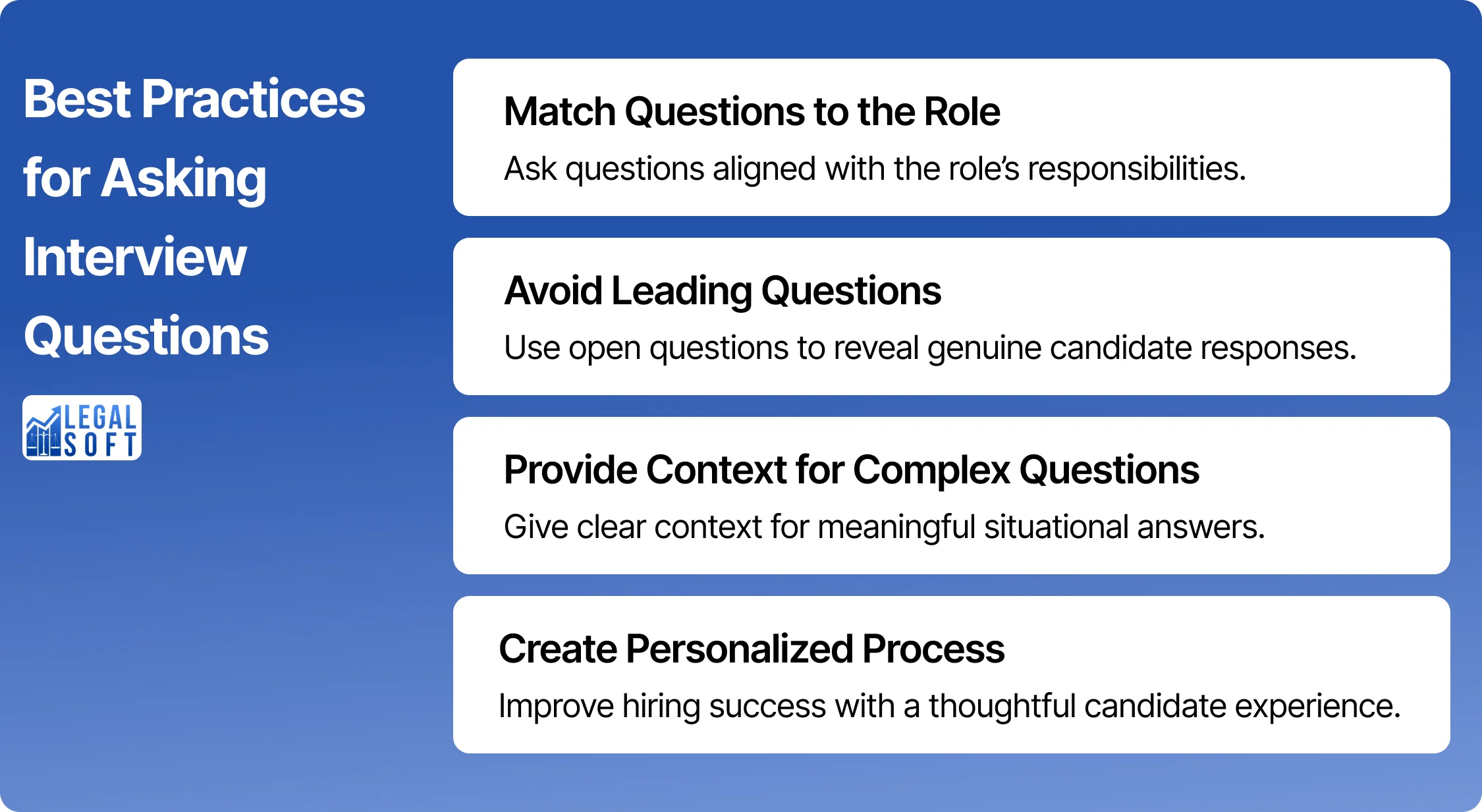
Match Questions to the Role
Customize your question to the specific responsibilities of the position you're filling. An interview for a paralegal should look different from one for a senior attorney, as their core duties aren't the same.
Avoid Leading Questions
Leading questions signal the answer you're looking for, which undermines the whole point of asking. Instead of "You're comfortable working under tight deadlines, right?" try "How do you manage your workload under multiple deadlines?" ask open ones that let candidates reveal their real approach.
Provide Context for Complex Questions
If you're asking a situational question, give the candidate enough context to answer it meaningfully. Dropping a vague hypothetical question without background information often leads to vague responses.
Create Personalized Process
The candidate experience during interviews can make or deter your hiring success. In fact, according to the 2025 CareerPlug report, 33% of job seekers have abandoned applications that require lengthy or impersonal processes, such as one-way video interviews.
Simplify Your Hiring Process With Legal Soft
At Legal Soft, we take the heavy lifting out of legal hiring. Our specialized recruiters focus exclusively on the legal industry, handling the vetting and screening process so your firm can choose from pre-qualified candidates.
If you're looking for full-time virtual support staff, we make finding top legal talent faster and less stressful. Sign up to our platform and explore pre-vetted candidates who can start immediately.
Frequently Asked Questions
What are legal interview questions?
Legal interview questions designed to evaluate legal knowledge, ethics, judgment, and professional fit. They go beyond generic interview questions to test the skills and qualities that matter most in legal practice.
How do you screen the right legal candidate?
Start with a clear understanding of the role’s requirements, then use a structured set of questions that test relevant skills and real-world scenarios. Combine this with credential verification, reference checks, and a consistent scoring system to compare candidates fairly.
How many interview rounds should a law firm conduct?
Most law firms conduct 2–3 interview rounds. This typically includes an initial screening, an interview with team members the candidate will work closely with, and sometimes a final meeting with firm leadership. More rounds may be appropriate for senior roles, but the process should remain efficient to avoid losing strong candidates to competing offers.