

Lawyers in the United States earn a solid income, with an average salary of $151,160 per year, according to the U.S. Bureau of Labor Statistics. Many enter the profession to achieve financial security and a comfortable lifestyle. However, for some attorneys, that income is just enough to cover daily expenses, bills, and student loans.
Adding a side hustle as an additional income stream can be a smart move, even for lawyers. Today, there are many flexible options available. A lawyer side hustle is a paid job or business you take on alongside your primary full-time work to generate extra income. It can improve your financial stability and give you the opportunity to explore alternative career paths without leaving your current job.
That said, it’s important to consider how you will manage your time effectively. Being a lawyer is already demanding, with long working hours and high responsibilities. Taking on extra work requires proper planning to avoid burnout, especially with reports showing that attorneys feel burned out nearly half the time at work, according to the Bloomberg Law Attorney Workload and Hours Survey (2024).
If you have the capacity and are looking for side hustles that fit your schedule and expertise, this guide covers ten practical options to help you get started.
Key Takeaways
- Lawyers can make extra money through side hustles like freelance legal services, bar prep tutoring, and legal content writing without leaving their full-time job.
- Top money-making side hustles for lawyers include legal consulting, which can reach up to $500 per hour, and freelance legal services, which can range from $30 to $300+ per hour.
- Passive income options for lawyers include selling digital legal products, investing in ETFs or dividends, and real estate investing.
10 Side Hustles for Lawyers to Earn Extra Income

Lawyers can make extra money by choosing side hustles they can balance alongside their primary job. The key is to find work that matches your existing skills and can be done without affecting your full-time work. Here are 10 side hustle options you can consider:
1. Bar Prep Tutoring
According to the National Conference of Bar Examiners, around 70,000 law graduates take the bar exam each year. With this number, many candidates look for structured guidance to improve their chances of passing, especially in competitive jurisdictions. This creates a practical side hustle for lawyers, allowing you to monetize your legal expertise through tutoring.
The steady demand leading up to the February and July exam cycles makes tutoring a reliable and recurring opportunity. Digital platforms and video conferencing tools make it easy to reach students beyond your local area. You can offer your services in multiple formats, including:
- One-on-one coaching: Work closely with a student to target weak areas, refine study strategies, and provide personalized feedback.
- Small group sessions: Teach multiple students at once, covering key topics while encouraging discussion and shared learning.
- Essay grading: Review and critique practice essays to help students improve issue spotting, analysis, and writing skills.
- Full review programs: Create structured prep courses that guide students from start to finish.
Pros:
- Reinforces your legal knowledge while improving your communication and teaching skills
- Builds credibility, especially if you plan to move into teaching or speaking
- Creates opportunities to expand into full bar review programs or develop digital products over time
Earnings Range: Most bar exam tutors charge around $200 per hour, but total earnings can reach several thousand dollars per exam cycle, depending on your pricing and number of students.
2. Freelance Legal Services
Freelance legal services allow you to offer your expertise on a flexible, project-based basis outside traditional firm structures. This can include drafting contracts, providing legal advice, assisting with compliance, or supporting small businesses with legal matters.
According to Statista’s Gig Economy, the number of freelancers in the United States is projected to reach 86.5 million by 2027, making up 50.9% of the workforce. This reflects a broader shift toward on-demand professional services, creating more opportunities for lawyers to provide flexible legal support.
Online platforms like Legal Soft and Remote Attorneys connect attorneys who can work remotely with law firms that need on-demand legal help. These platforms lower the barrier to entry, making it easier to find clients, work globally, and build your own independent reputation. This model is especially appealing if you want more control over your workload and schedule.
Pros:
- Lets you explore other practice areas without fully committing
- Can lead to transitioning into full-time independent practice
- Benefits from the growing demand for flexible legal services
Earnings Range: $30 - $300+ per hour (Upwork)
3. Adjunct Law School Instructor
Adjunct roles are typically part-time, usually involving one or two courses per semester, making them manageable alongside your legal work. Teaching gives you the opportunity to share real-world insights, mentor future lawyers, and engage with academia. While compensation varies by institution, the role provides long-term career benefits beyond immediate earnings.
Pros:
- Strengthens your professional credibility and authority in your field
- Provides networking opportunities with faculty, students, and visiting scholars
- Can open doors to more advanced academic roles over time
Earnings: $2,000 - $10,000 per course (National Association for Law Placement)
4. Legal Researcher (Contract-Based)
Contract-based legal research is an ideal side hustle if you prefer analytical work without direct client interaction. Law firms and corporations often outsource research tasks to manage workload, creating steady demand for lawyers who can deliver accurate and timely insights.
Your work may involve analyzing case law, statutes, and regulations, as well as preparing legal memoranda or briefs. Since it’s project-based, you can choose assignments that match your expertise and schedule. Remote opportunities also make it accessible no matter where you are.
Pros:
- Lets you focus on analytical work with no client-facing pressure
- Offers flexible, project-based assignments
- Helps you stay current on evolving case law across practice areas
Earnings range: $36 to $110+ per hour (ZipRecruiter)
5. Legal Content Writer

Legal content writing allows you to use your legal knowledge to improve a law firm's website visibility in search engine results through content. Unlike general content writers, your legal background helps you handle complex topics accurately and explain them in a clear way that non-legal audiences can understand.
Your typical workday may involve writing blog posts, website copy, whitepapers, or thought leadership articles. Your expertise and credibility make you valuable to law firms and legal businesses, especially with strict standards like E-E-A-T that influence search rankings.
Pros:
- Offers flexibility to take on multiple projects or maintain ongoing client work
- Helps you build authority and a personal brand through published content
- Can lead to opportunities like speaking engagements or consulting
Earnings Range: $40 - $100 per hour (ZipRecruiter), or $100+ per article
6. Legal Consultant
This legal side hustle is ideal for lawyers who prefer advising businesses or organizations on legal strategy, compliance, or risk, rather than handling direct representation.
Startups, nonprofits, and mid-sized companies often hire legal consultants on a retainer or project basis to access legal expertise without the cost of a full-time attorney. This gives you flexibility in structuring your work engagement, whether through one-time projects or ongoing advisory roles.
Pros:
- Offers high earning potential, especially in specialized or regulated industries
- Lets you contribute to high-level business decisions
- Can grow into a standalone consulting business
Earnings: $30 to $500+ per hour, depending on your experience, area and specialization
7. LSAT Tutoring
With many candidates aiming to get into law school with a high LSAT score, students are willing to invest in preparation to improve their results. As a law school graduate, you’ve already cleared this hurdle, and students will pay for guidance from someone who has successfully gone through the process.
LSAT exam takers are active year-round, with peak seasons in the spring and fall. Attorneys who scored in the 170s can charge higher rates and often attract more students.
Pros:
- Strong hourly rates with flexible scheduling
- No ongoing CLE or licensing requirements, your J.D. is your credential
Earnings Range: $25 - $300+ per hour
8. Contract Reviewer
Contract review is a high-demand service, especially among startups and growing businesses. Many companies turn to attorneys for project-based contract review work, which can often be done entirely remotely.
Your role is to identify risks, ensure compliance, and protect your client’s interests, commonly seen in M&A due diligence, real estate transactions, and vendor agreements. The work can range from reviewing simple agreements to handling complex, multi-document deals.
Pros:
- Lets you take on projects that fit your schedule and balance with other side hustle gigs
- Focusing on certain industries or contract types can increase demand and justify higher rates for your expertise
Earnings: $40 - $200 per hour (ZipRecruiter)
9. Video Content Creator

If you enjoy creating videos or sharing short clips of your day, you can turn that into a side hustle through video content creation. It allows you to share your legal knowledge while building a public-facing brand.
According to FindLaw’s 2024 U.S. Consumer Legal Needs Survey, 1 in 6 people who search for legal information online prefer video content. This shows that many people find videos easier to understand when learning about legal topics.
As a lawyer, you can create videos such as:
- Short clips answering common client questions
- Explanations of legal concepts in simple terms
- Reactions to current legal news
- Videos addressing common legal misconceptions
You can also create content for law firms looking to attract and engage audiences on platforms like YouTube, LinkedIn, and Facebook. With consistent effort and audience-focused content, you can grow a strong following over time.
Pros:
- Opportunities to monetize video through ads, sponsorships, affiliate marketing, and digital products
- Helps establish you as a thought leader and public-facing expert
- Can lead to additional opportunities like courses, podcasts, and webinars
Earnings range: Varies widely, from minimal income for beginners to tens of thousands per month, depending on your audience size and monetization strategy
10. Legal Transcriptionist
For attorneys with strong typing skills and attention to detail, legal transcription is a quiet and flexible side hustle for lawyers. It involves converting audio recordings into written documents, such as depositions, court proceedings, and legal dictations. While transcription software exists, many law firms still prefer human transcriptionists for accuracy, especially in sensitive matters.
This work requires strong listening skills, attention to detail, and often fast typing speeds, typically 60+ words per minute. It is also less intellectually demanding than other options on this list, making it a good choice for days when you want to earn without heavy mental workload.
Pros:
- Can be done remotely and self-directed
- Can be easily combined with other side hustles to supplement your income.
- A practical option for lawyers with flexible or varying schedules
Earnings: $15 - $22 per audio hour (TranscribeMe)
4 Passive Income Ideas for Lawyers
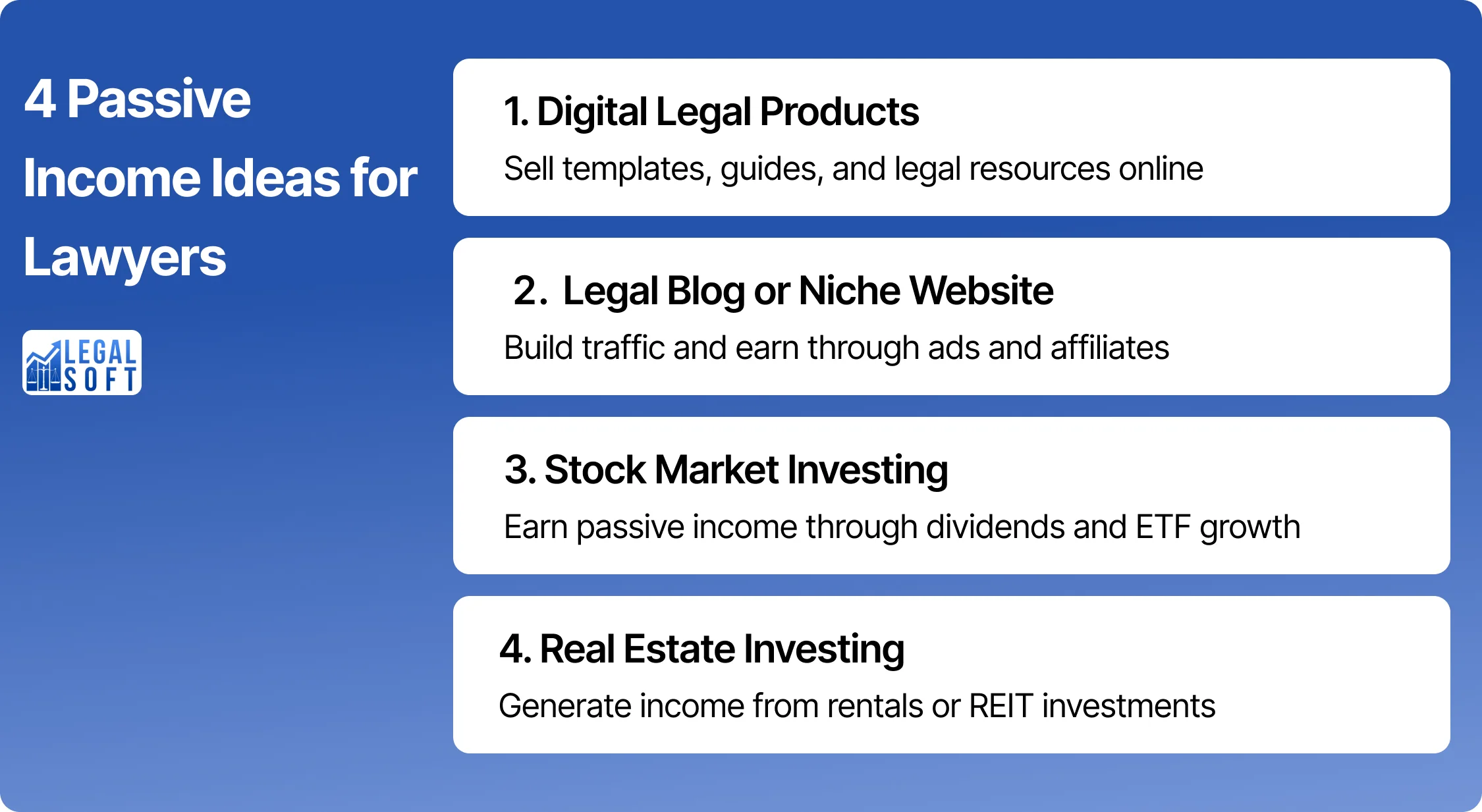
1. Digital Legal Products (Templates, Guides)
Lawyers spend years developing skills and expertise in creating contracts, procedures, and structured agreements. Most people outside the legal profession don’t know how to do this, and they’re willing to pay for resources and tools that make it easier.
Digital legal products allow lawyers to package their expertise into reusable assets that both legal professionals and non-lawyers can use, such as:
- Contract Templates: Pre-drafted agreements for common legal needs that users can customize
- Compliance Checklists: Step-by-step guides to help startups, freelancers, and small businesses stay compliant
- Legal Guides: Resources that explain legal concepts in plain language
Once created, these products can generate recurring income with minimal ongoing effort, especially when sold through personal websites or online marketplaces. Lawyers can further enhance their value by bundling products, offering updates, or integrating them into subscription models.
2. Legal Blog or Niche Website
A legal blog or niche website is a long-term asset that can generate passive income while building your online presence. By consistently publishing high-quality, SEO-optimized content you can attract people actively searching for legal information.
Once you start getting traffic, you can turn it into profit through display ads (like Google AdSense), affiliate partnerships, sponsored content, or by directing readers to your own legal services.
The key is focusing on a niche where you can show real expertise that your audience is looking for. A general legal blog faces heavy competition, but a site focused on a specific area—such as tenant rights in a particular state—has a better chance to rank faster and attract the right audience.
Traffic compounds over time as more content gets published and indexed, meaning a post you write today can continue generating traffic and revenue in the future.
3. Stock Market Investing (Dividends, ETFs)
When lawyers think about a steady source of income, employment is usually the first option. But actually, your income is enough to work in the market. Dividend investing and index ETFs are particularly well-suited for busy professionals because they require minimal active management.
Dividend stocks can provide a passive way to grow your wealth just for holding shares, while broad market ETFs like those tracking the S&P 500 help grow wealth over time through market gains and reinvested returns. You can benefit from:
- Passive Income: Receive dividends without active involvement.
- Wealth Growth: Compounding helps your portfolio grow alongside your primary income
- Low Time Commitment: Requires minimal effort, making it a truly passive strategy
4. Real Estate Investing (Rentals, REITs)
Real estate has created more millionaires than almost any other asset class, and lawyers have the knowledge and skills to also grow in this space. You understand contracts, can navigate real estate transactions, and can spot issues that untrained investors may miss.
Here are a few ways to generate passive income through real estate:
- Short-Term Rentals: Rent out a spare room, vacation property, or investment unit on platforms like Airbnb
- Long-Term Rental Properties: Own and rent residential or commercial properties to generate steady monthly income.
- Real Estate Investment Trusts (REITs): For lawyers who want real estate exposure without managing property, REITs are publicly traded companies that own income-generating real estate and are required to distribute at least 90% of their taxable income as dividends, making them an accessible passive income stream.
Tips for Lawyers Starting a Side Hustle
1. Manage Time Effectively
Time management is one of the most important factors when balancing multiple job responsibilities. You need to maintain focus while ensuring the quality of your work does not suffer. Set clear boundaries by assigning specific hours for your side hustle and prioritizing tasks based on urgency. Use tools that can help you manage your time, tasks, and workload.
2. Stay Compliant with Ethical Rules
Before starting a side hustle, you must fully understand and comply with the ethical rules in your jurisdiction. This includes regulations on outside employment, conflicts of interest, fee-sharing, and client confidentiality.
Maintaining professional integrity is important, as even well-intentioned side projects can create legal or reputational risk if standards are overlooked. Document any required disclosures or approvals from your firm or regulatory body, and consult mentors or ethics committees for guidance.
3. Start Small and Scalable
Begin with a manageable, low-risk project so you don’t overwhelm your schedule or resources. Small initiatives such as freelance writing, tutoring, or contract review let you test the waters, gather feedback, and refine your approach before committing time or capital.
As your side hustle gains traction, you can expand into higher-value opportunities like consulting, content creation, or digital product sales. Starting small helps you balance your full-time job while exploring new income streams.
4. Use Your Existing Expertise
Choose a side hustle that aligns with your current legal knowledge or professional interests so you can gain a clear advantage. By using skills you already apply in practice, such as contract drafting, research, or advising, you can deliver value quickly with minimal adjustment or training.
5. Delegate Tasks
Review your workload and identify tasks that do not require your direct expertise. These may include administrative work, scheduling, data entry, or basic legal support tasks. Delegating these responsibilities allows you to focus on higher-value work and grow your side hustle.
You can also work with providers like Legal Soft, which offer trained virtual legal staff who can support your firm right away. This helps improve your productivity and save you time on hiring.
Final Thoughts
Side hustles are a rewarding experience you can take on alongside your legal practice. They offer a practical way to increase your income and explore new professional interests. But, managing your time and work-life balance is important, as trying to do too much at once can reduce the quality of your work.
From tutoring to legal content writing, the key is to choose opportunities that align with your skills, follow ethical guidelines, and fit your schedule. With the right approach, a side hustle can provide additional income and may grow into a steady passive income stream that strengthens your financial security.
Frequently Asked Questions
*The information provided in this article is for general informational purposes only and does not constitute legal or financial advice. Always consult a qualified professional before making any legal, financial, or career-related decisions.