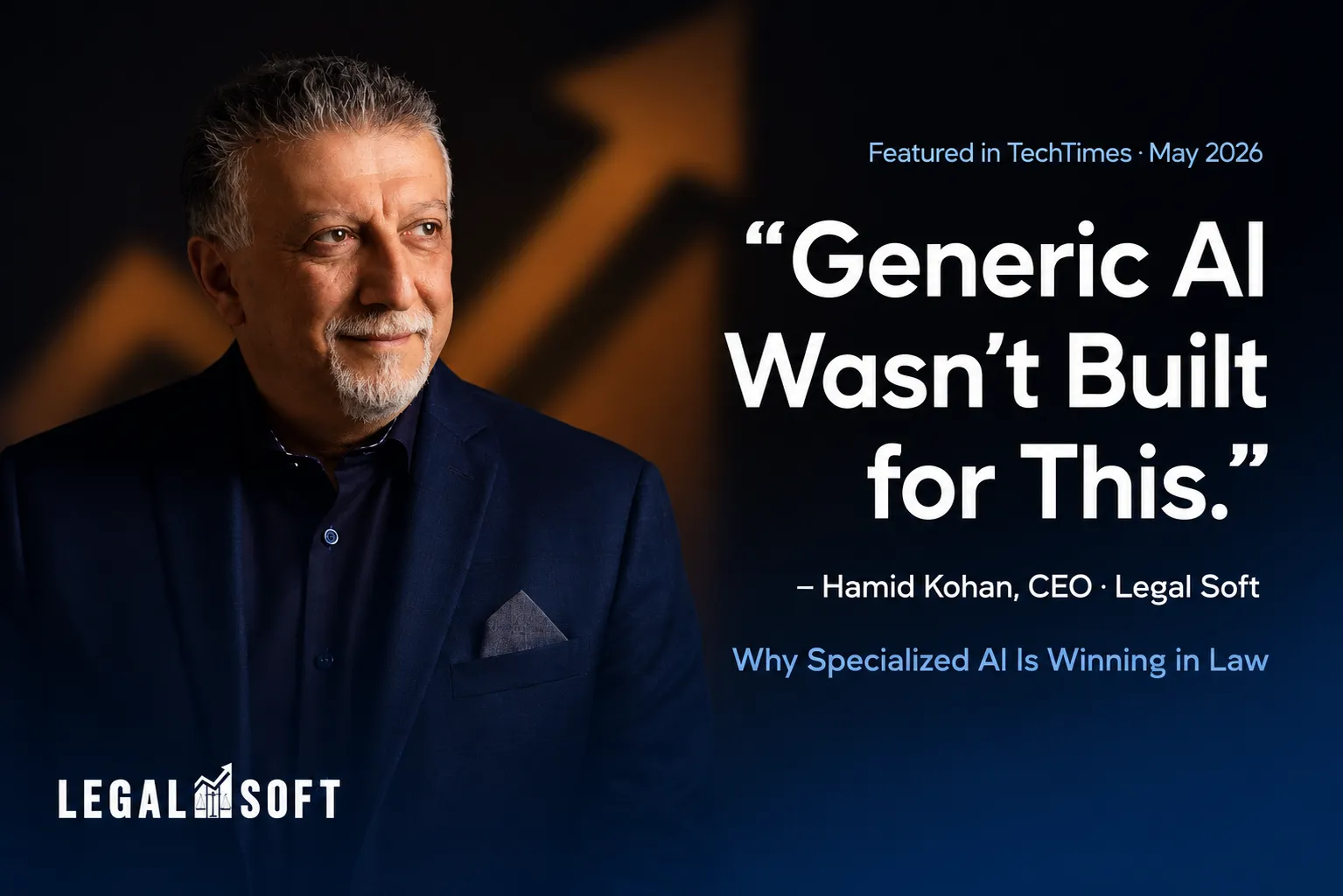
Los Angeles, CA (June 16, 2026) - Hamid Kohan, founder and CEO of Legal Soft and Law Practice AI, was interviewed by Authority Magazine for its series on AI entrepreneurs, in a conversation conducted by Rachel Kline. The interview covers his path from Silicon Valley into legal operations and his case for why AI works best when it's designed around a specific industry's workflows.
Kohan grew up in Northern California and finished his engineering degree at 17. He spent about 20 years building and leading technology companies in Silicon Valley, earned an MBA, and later ran the North American division of an Israeli tech company before launching his own data management firm. He never planned to work in legal.
The shift came through one of his employees. The employee was frustrated about his own legal case, so Kohan went with him to the law firm handling it. He learned the firm had missed the statute of limitations deadline and the case was gone. He helped negotiate a resolution in the room, then started asking how a mistake like that could happen operationally.
The firm's owner described how disorganized and overwhelmed many firms were. Kohan offered to look at the business side. What he saw surprised him. The workflows, staffing, technology, and reporting were years behind what he'd worked with in tech. He began consulting for that firm as a side project, restructured its operations, and the practice doubled. Other firms started calling. He eventually built Legal Soft, and later Law Practice AI.
Why he built Law Practice AI the way he did
Kohan told Authority Magazine that AI was a natural step from the operational work his team was already doing. Firms kept hitting the same problems including repetitive administrative work, document-heavy workflows, and disconnected systems.
When AI became practical enough to address those problems, he saw that most generic tools weren't developed for legal work. Legal work is structured, compliance-heavy, and deadline-driven, and a chatbot alone doesn't solve that.
"The biggest opportunity in AI is not replacing professionals," Kohan said. "It is reducing operational friction so professionals can focus on higher-value work."
That thinking shaped how he developed the platform. Instead of one isolated function, he built an end-to-end system covering intake, document collection, summarization, drafting, organization, and case management.
The moment the value became clear
Kohan pointed to one capability that changed how he saw the technology: watching AI summarize and organize large case files in minutes.
A single matter can involve hundreds or thousands of pages of medical records, employment records, contracts, and emails. Firms traditionally assigned several staff to organize and summarize that material over weeks. AI can produce chronologies and structured summaries in minutes, which frees attorneys and staff to spend time on strategy and client work instead.
The obstacle is adoption
Kohan was direct that the hardest part hasn't been the technology. Firms hesitate over accuracy, compliance, confidentiality, and concerns about replacing staff. The flood of single-purpose AI tools made it worse, because firms don't want 8 different subscriptions from 8 different vendors.
His answer was to focus on workflows rather than hype, positioning AI as operational infrastructure that fits how a firm already works. He cited one firm that grew past 300 employees using a mix of virtual staffing, workflow changes, and AI-supported operations.
What he thinks comes next
Kohan laid out where he sees AI heading in professional services. He expects specialized, industry-specific AI to outperform generic tools, and he expects the best results to come from systems that connect a full workflow rather than solving isolated tasks.
He also described how he thinks firms will be structured: roughly one-third AI, one-third virtual staffing, and one-third in-house staff working together. He sees that mix giving smaller firms operational capabilities that used to be available only to large ones.
His advice to other founders was to solve real operational problems instead of building technology first and looking for a use afterward.
"Don't stand in front of a moving train," Kohan said, describing how he views technological change. "You can either resist change or learn how to use it to your advantage."
About Hamid Kohan
Kohan is the founder and CEO of Legal Soft, a virtual legal staffing firm working with law firms across the United States, and the founder of Law Practice AI, a workflow automation platform designed for personal injury law firms. He has more than 30 years of experience in technology and business, has written 3 books on law firm growth including "How to Scale Your Stupid Law Firm," and speaks regularly on AI and legal innovation.