Key Takeaways
- Most law firms lose potential clients at intake because no one answers, follow-up stalls, or the prospect can’t get clear answers on cost and next steps.
- In Clio’s 2024 secret shopper study, 48% of law firms were unreachable by phone and only 33% replied to emails.
- Firms using online intake forms, schedulers, and e-signatures report higher revenue and better conversion rates.
- The fix is a documented intake process, a lead tracking system, and one person who owns intake every business day.
- A dedicated intake specialist keeps response times consistent without pulling attorneys or paralegals off billable work.
Law firms lose potential clients during intake when calls go unanswered, follow-up is slow, and prospects can’t get straight answers. The person needing help doesn’t wait. They call the next firm on the list.
This guide covers the seven most common law firm intake problems. Each one includes the warning sign to look for and the fix that works.
Why Do Law Firms Lose Potential Clients During Intake?
Law firms lose potential clients during intake because the first contact fails. The prospect reaches voicemail, waits days for an email, or hangs up without knowing what happens next.
Clio’s 2024 Legal Trends Report tested this directly. A research firm contacted 500 U.S. law firms posing as prospective clients. Here is what the shoppers found:
- 48% of firms were unreachable by phone, even after a message was left.
- 40% of firms picked up when called.
- 33% of firms replied to an email inquiry.
- 41% offered rate information by phone, and only 12% could estimate the total cost.
- 36% explained the process and next steps by phone.
- 73% of shoppers were unlikely to recommend the firm they reached.
The last number matters most for growth. A bad intake call doesn’t just lose one matter. It also costs you the referrals that person would have sent.
7 Common Law Firm Intake Problems and How to Fix Them
1. Calls go unanswered
Unanswered calls are the most expensive intake problem because the prospect often never tries again. Calls get missed during depositions, hearings, lunch, and after hours.
Personal injury firms feel this most. Accidents don’t happen on a schedule, and injured people call whoever picks up first.
Fix: Assign live phone coverage for every business hour. Route overflow and after-hours calls to a person or service that can capture case details. Set a rule that every voicemail gets a callback the same business day.
2. Leads wait too long for a response
A slow response tells the prospect your firm is too busy for them. Web forms and emails are the worst offenders because no phone is ringing to prompt action.
Fix: Set a response standard for every channel and track it. A practical starting point is a reply within the same business day, and faster for urgent matters like arrests or injuries. Turn on instant alerts for form submissions so they reach a person, not a shared inbox.
3. Follow-up stops after one attempt
Many prospects don’t answer the first callback. Without a follow-up sequence, those leads quietly disappear.
This gets worse when lead volume spikes. A busy week can bury dozens of half-finished inquiries.
Fix: Write a follow-up sequence and use it every time. For example: a call and text on day one, an email on day two, and a final call on day five. Log every attempt in the same record so nothing is repeated or missed.
4. Poor screening fills the pipeline with bad leads
When intake doesn’t screen, attorneys spend consultations on matters the firm can’t or won’t take. Strong cases then wait behind weak ones.
Fix: Write qualification questions for each practice area. Cover jurisdiction, deadlines, conflicts, and case type before a consultation is booked. Refer out leads that don’t fit, and track which marketing sources send them.
5. Prospects can’t get clear answers on cost
People hesitate to book when they can’t learn what representation might cost. Only 12% of firms in Clio’s study could estimate total cost by phone.
Flat fees make this easier to explain. According to Clio’s 2025 report for solo and small firms, 75% of solos and 65% of small firms use flat fee billing.
Fix: Give intake staff approved fee scripts. They should explain how billing works, what a consultation costs, and what happens next. They should never quote case outcomes or give legal advice.
6. Intake lives in inboxes and sticky notes
Without one system, no one knows how many leads came in, who called them back, or why they didn’t sign. Leads fall through the cracks between people.
Software alone doesn’t fix this. A tool only works when someone keeps every record current.
Fix: Track every inquiry in your CRM or case management system from first contact to signed retainer. Use online intake forms so details land in the record automatically. Review the pipeline weekly.
7. Attorneys and paralegals are handling intake
When lawyers answer intake calls, two things suffer. Billable work slows down, and new leads wait until the attorney is free.
Fix: Make one trained person the owner of intake. Attorneys should join the process at the consultation, not the first call.
Why Is My Law Firm Getting Calls But Not Signing Cases?
If calls are coming in but cases aren’t signing, the breakdown is usually after first contact. Look for these signs:
- Consultations are booked, but many prospects don’t show up.
- Retainer agreements go out, but no one follows up on unsigned ones.
- Prospects ask about cost and next steps, but get vague answers.
- No one can say how many leads came in last month or where they went.
Each sign points back to one of the seven problems above. Start with the one that loses the most leads.
How to Re-Engage Prospects Who Didn't Finish Intake
A prospect who started intake and stopped is still interested. They often got busy, confused, or stuck on one step.
- Reach out within one business day by phone and text.
- Name the step they stopped at and offer to finish it together.
- Answer the likely blocker directly, such as cost, paperwork, or timing.
- Send a link to book a time or complete the form online.
- Close the record after a set number of attempts, and note the reason.
Tracking why leads stall shows you which step in your process needs work.
Legal Intake For Mid-Sized Law Firms
Mid-size law firms face intake problems at higher volume. More practice areas, more marketing channels, and more staff mean more places for a lead to get lost.
Clio’s 2025 report on mid-sized firms shows why. Only 16% of mid-sized firms say referrals are their top lead source, compared with 51% of smaller firms. That means more leads come from marketing, and those leads need faster handling.
The same report found only 38% of mid-sized firms use legal practice management software, compared with 71% of smaller firms. Mid-sized firms using online intake forms and e-signatures each saw 12% better conversion rates.
For mid-size firms, the fix is structure. Use one intake script per practice area, one shared lead record, and clear handoff rules to each team. Our page on staffing support for mid-size law firms covers how firms at this stage add capacity.
How to Improve Your Law Firm Intake Process: A 6-Step Plan
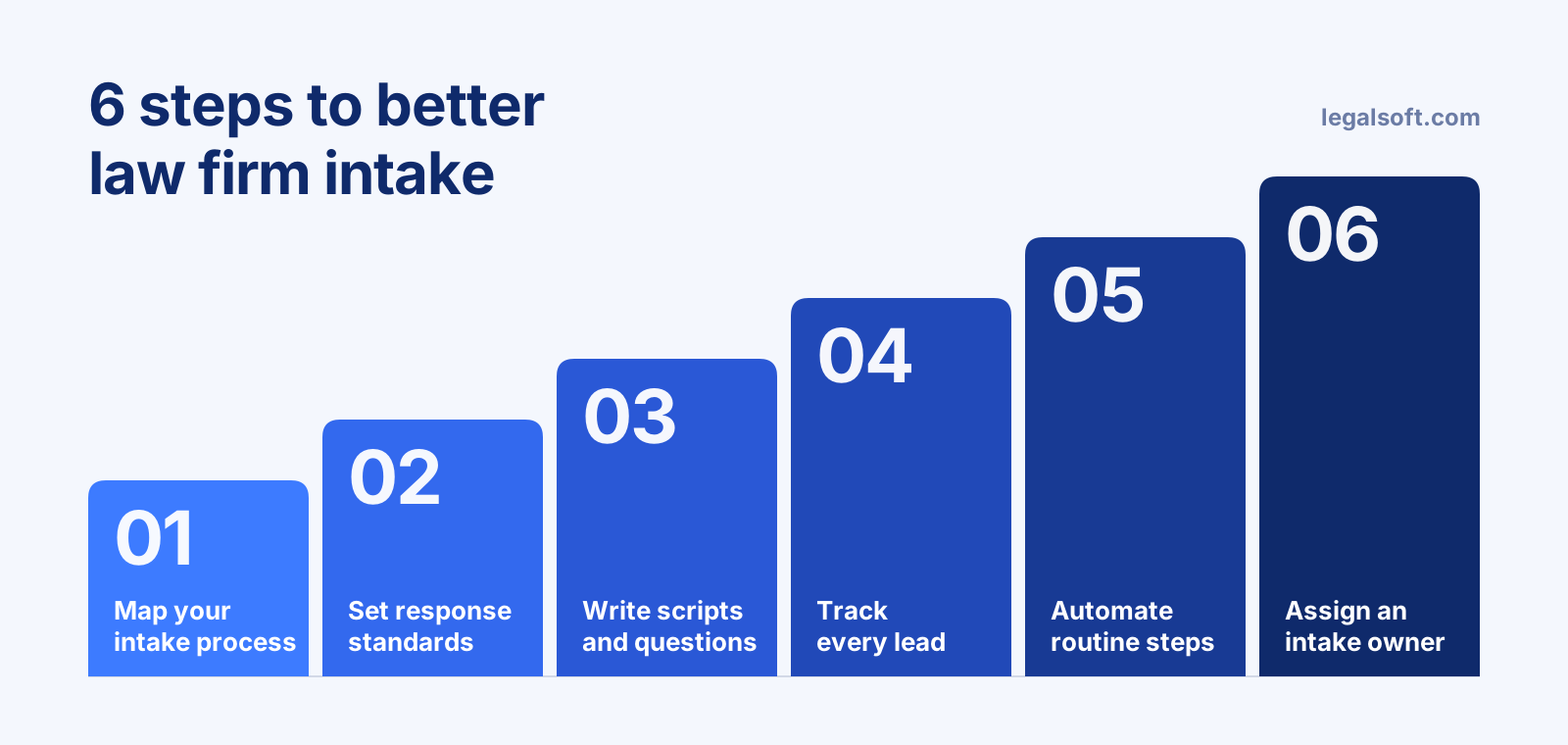
- Map your current intake process. Write down every step from first contact to signed retainer, with an owner for each.
- Set response standards. Decide how fast calls, forms, emails, and texts get a reply.
- Write scripts and qualification questions. Cover screening, fees, and next steps for each practice area.
- Track every lead in one system. Use your CRM or case management software, not inboxes.
- Automate the routine steps. Use online forms, schedulers, text reminders, and e-signatures.
- Assign a dedicated intake owner. Give one trained person responsibility for response times and follow-up.
The automation step pays off. In Clio’s 2025 solo and small firm data, solo firms using e-signatures, online search ads, online schedulers, intake forms, and text messaging saw 48% more client leads. For a deeper walkthrough of each stage, see our guide to improving and streamlining your law firm’s client intake.
Where a Virtual Intake Specialist Fits
A virtual intake specialist is a remote team member who handles your firm’s first contact with prospective clients. They answer inquiries, screen leads, schedule consultations, and follow up until each lead signs or closes.
Legal Soft’s remote legal intake specialists handle:
- Calls, emails, and chat inquiries
- Pre-qualification based on your firm’s intake criteria
- Case details entered into your CRM or case management system
- Consultation scheduling with attorneys or paralegals
- Follow-up on missed calls, form submissions, and incomplete intakes
- Retainer agreements and initial client forms
They work inside the tools you already use, including Clio, MyCase, Filevine, PracticePanther, Lawmatics, and Lead Docket. Processes are set by U.S.-based legal teams, and work runs on secure, encrypted platforms.
Full-time intake specialists through Legal Soft start at $1,740 per month. To learn more about the role first, read what a legal intake specialist does. When you’re ready, you can browse available intake specialists and request interviews directly.
Frequently Asked Questions
What are the most common law firm intake problems?
The most common law firm intake problems are unanswered calls, slow responses to web leads, and weak follow-up. Others include poor screening, unclear pricing, no tracking system, and attorneys handling intake themselves.
Why do law firms lose potential clients during intake?
Law firms lose potential clients when the first contact fails. Prospects reach voicemail, wait too long for a reply, or can’t learn costs and next steps. Most then contact another firm.
How fast should a law firm respond to a new lead?
A law firm should respond to a new lead as quickly as possible, ideally the same business day. Urgent matters, like injuries or arrests, need a response within minutes or hours. Set a written standard and track it.
How can a law firm re-engage prospects who did not finish intake?
Contact them within one business day by phone and text. Name the step where they stopped, answer the likely blocker, and send a link to finish online. Close the record after a set number of attempts.
How can a mid-size law firm keep intake working when lead volume spikes?
Use one shared lead record, written follow-up sequences, and clear handoff rules. Add dedicated intake staff so response times hold steady when volume rises.
How can a personal injury firm stop missing intake calls after hours?
Route after-hours calls to a live person or intake service that captures case details. Then call every lead back first thing the next business day.
Should attorneys handle client intake themselves?
In most firms, no. Attorney time is better spent on consultations and casework. A trained intake specialist can handle first contact, screening, and scheduling, then hand qualified leads to the attorney.
Final thoughts
Intake is where your firm wins or loses a client. Fixing it rarely takes new marketing spend. It takes faster responses, steady follow-up, and one person who owns the process.
Start with the problem that costs you the most leads. Then build the system around it.
Ready to stop losing leads at intake? Talk to Legal Soft about adding a trained intake specialist to your team.