

When someone calls a law firm about a potential case, the first few minutes often decide whether they hire that firm or move on to the next name on their search. Intake is that first impression, and it shapes whether a lead ever becomes a client.
Many firms handle it poorly because the people answering new calls are also doing legal work, already gone for the day, or otherwise unreachable. Outsourcing intake is one way firms try to fix that gap. This guide explains what legal intake outsourcing is and gives you a clear view of what you can gain and what to watch out for.
What is legal intake outsourcing?
Legal intake outsourcing for law firms is the practice of delegating the initial contact and screening of potential clients to external service providers. That contact can come through a phone call, a website form, a live chat, or a text message.
Typical intake tasks being outsourced are answering calls, screening potential clients, gathering case details, running a basic conflict check, and scheduling a consultation with an attorney. These tasks are all transferred to external companies or remote intake professionals instead of using the firm's own internal staff.
The provider answers calls and messages under the firm's name, follows scripts the firm approves, and passes qualified leads back to the firm through a shared system or CRM. The work can run during business hours, after hours, on weekends, or around the clock, depending on the agreement.
What are the top reasons law firms outsource legal intake?
Firms outsource intake for reasons that are usually tied to recurring problems that doing it in-house struggles to solve.
With salary savings of up to 70% when outsourcing tasks to a remote intake specialist compared to hiring locally in the United States, cost is clearly one of the top reasons. Many small firms don’t have the budget or the call volume to justify an in-house hire, so outsourcing lets them pay only for the coverage they use.
Coverage is another reason. Legal matters don't follow business hours, and neither does the moment a prospect decides to call. Many inquiries arrive at night, on weekends, and even during holidays. A firm with staff working 9 to 5 misses those calls, while outsourcing can provide 24-hour coverage.
Then there is focus. According to the 2025 Clio’s Legal Trends Report, lawyers capture only 3.0 billable hours in an average 8-hour workday. In their working time, they spend five hours each day on non-billable work. Clearly, reducing administrative tasks like intake helps lessen that burden and opens up more time for billable work.

Benefits of Outsourcing Legal Intake
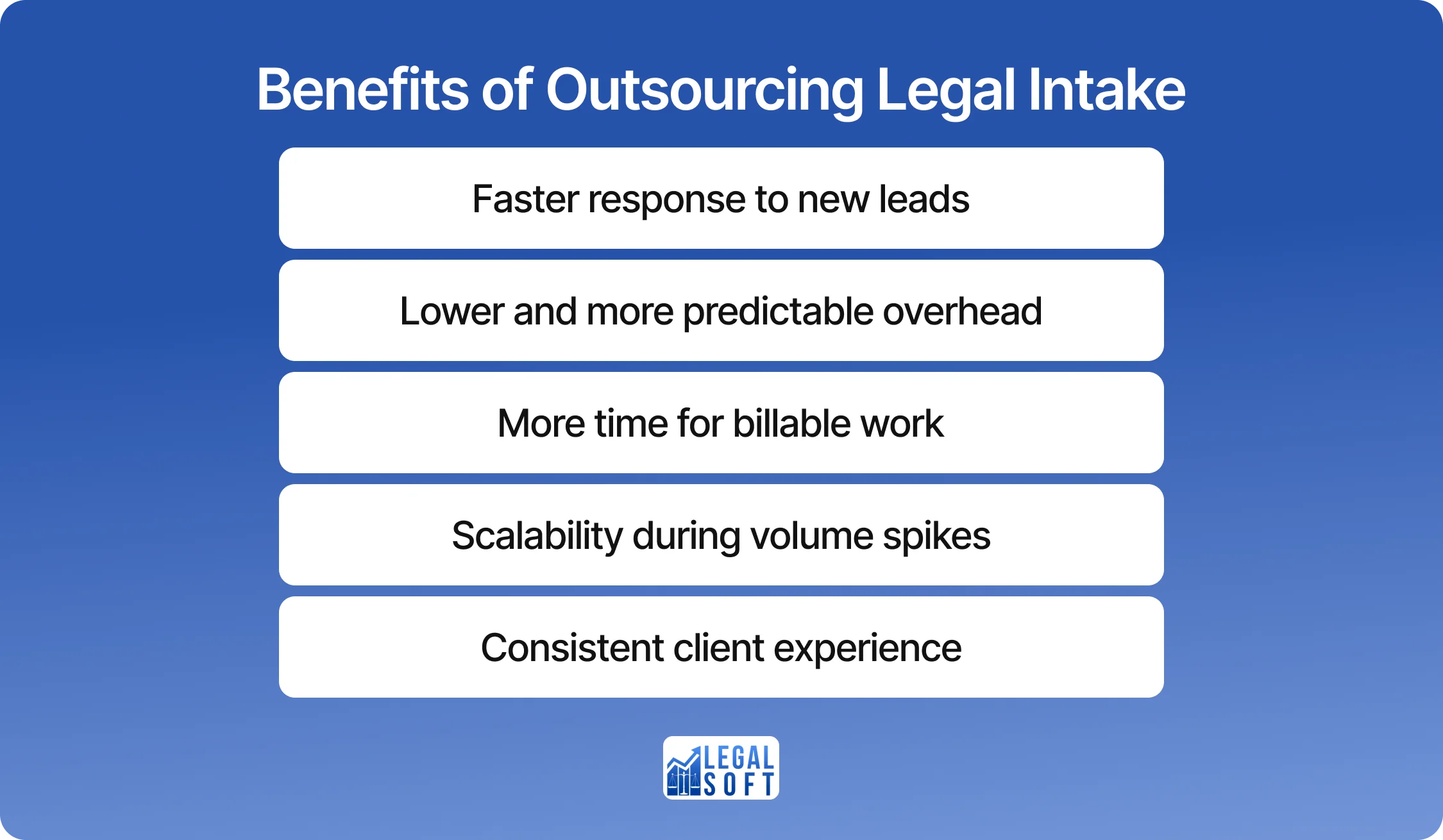
After knowing the reasons behind the “why” law firms turn to outsourcing, let’s break down the key benefits of working with external providers.
Faster response to new leads
An outsourced intake team answers calls and form submissions in real time, often within seconds. That speed is one of the biggest factors in legal intake because a potential client who reaches a live person on the first try is less likely to keep calling other firms.
Prospects reach out under different kinds of circumstances, and many do it after standard working hours. When a request sits in an inbox until morning, you usually often open it to find they’ve already called another firm.
Lower and more predictable overhead
Hiring and retaining in-house intake staff carries real cost, plus benefits, software, and management time. When you factor in turnover, it also means repeating the long hiring and training process every time someone leaves. Outsourcing converts much of that into a predictable monthly expense.
You also avoid the productivity gap that comes with turnover and time off. Coverage stays consistent even when a single in-house hire would be out sick or on vacation.
More time for billable work
With intake handled, attorneys and paralegals stop handling calls that don't need their expertise. That time shifts back to legal work that actually generates revenue.
This matters given how thin billable time already runs. It also reduces the task switching that often wears teams down. Fewer interruptions mean better attention on the matters that need it.
Scalability during volume spikes
Marketing campaigns, referral surges, or seasonal demand can flood a firm with inquiries and calls. An in-house team gets overwhelmed fast, while an outsourced provider can scale coverage up or down.
You pay for the capacity you need rather than overstaffing for your busiest week. That flexibility is hard to match with fixed in-house hires.
Consistent client experience
Trained legal intake specialists follow a defined script and screening process on every call. Prospects get the same attentive first impression whether they call Monday morning or Friday night.
That consistency also improves screening quality. The right cases move forward to your attorneys, and poor-fit inquiries get filtered out before they consume billable time.
Structured follow-up matters too, since most leads need several touches before they decide to hire. Outsourced teams are experienced in this kind of workflow and can run those sequences for your firm.
Are there disadvantages of outsourcing legal intake?
Each firm has different situations and needs, so it's important to do your research and due diligence before engaging an outsourcing provider. With the many benefits come trade-offs worth weighing honestly. These are some of the challenges that outsourcing intake may bring:
Less direct control over the first impression
You're trusting an outside team with the first impression of your firm. When an outside team handles it, you give up some control over tone and judgment in the moment.
If the provider’s training or scripts don’t match your standards, intake quality can decline without you noticing right away. Good providers make it easy for you to have oversight and manage this risk with clear criteria, regular call reviews, and reporting.
Onboarding and knowledge gaps
An outside team may not know your firm's voice or local context the way an in-house hire would. A general intake agent or call center may not understand the difference between practice areas, or know the filing rules in a specific state.
But there are providers like Legal Soft that staff intake teams focused exclusively on legal work. This shortens the ramp-up of learning your brand and processes, since they're already experienced with handling law firm intake. It's worth seeking out companies like this when you compare options.
Data security and confidentiality concerns
Intake involves sensitive client information from the first contact. Sharing that data with a third party raises ethical duties around confidentiality and conflicts under the ABA Model Rules.
You'll need a provider with strong security practices, confidentiality agreements, and conflict-checking procedures. In a regulated profession, vetting how a third party stores your data, who can access it, and what compliance obligations apply is not optional.
Who benefits from outsourcing legal intake?

Outsourced intake helps firms of many sizes, but the gains are largest where intake volume is high or staffing is tight.
- Solo attorneys often handle intake between court appearances and client work. Outsourcing means calls get answered during the hours they're heads-down on legal work, instead of losing leads to voicemail.
- Small firms typically start without the resources for a dedicated intake role, so the duty gets split among busy staff. A provider gives them full coverage without adding a salaried position to the payroll.
- Personal injury and criminal defense practices win business on speed, since leads act fast after an accident, arrest, or urgent legal issue. Outsourced teams can respond quickly at any hour, which directly affects how many cases get signed.
- Growing firms invest in heavy marketing campaigns that bring in high volumes of calls and form submissions. Outsourcing scales with demand, so a sudden surge doesn't overwhelm the team or get dropped, and the marketing budget doesn't go to waste.
It’s also important to consider that outsourcing while outsourcing benefits teams, it still involves staff who must be managed under applicable labor laws. The right partner is transparent about what they cover, so confirm their practices upfront. That way the arrangement doesn't add headaches for your firm, and your intake stays within ethical and legal industry standards.
Final Thoughts
A client’s journey with your firm starts when someone answers their inquiry. Intake is where a potential client can become new business or walk away, so it's no surprise that more firms are weighing outsourcing for the cost savings and coverage it brings.
The decision comes down to your call volume and how many leads you're actually losing. Those two numbers usually tell you whether outsourcing would pay for itself. Choosing a provider is also like hiring in-house staff. You need to vet them, check references, and confirm they can handle the tasks you need help with.
Legal Soft provides legal intake specialists who work on behalf of your firm to handle the intake process. They work within your preferred or existing systems, following the scripts and criteria you set.
Ready to improve your intake process? Choose from candidates with vetted law firm experience and practice area specialization when you book a consultation.
FAQs
What legal intake services can I outsource?
You can outsource phone answering and texting, client intake form and live chat responses, lead qualification, conflict checks, appointment scheduling, and follow-up on cold leads. Many providers also enter data directly into your CRM or case management system. Firms often start with after-hours and overflow coverage before expanding to full intake.
How do you measure the success of outsourcing intake?
Track metrics you can actually measure with numbers. Speed to first contact is one, measured as the time between a new inquiry and your first response. Another is the lead-to-consultation rate, which shows how many inquiries turn into scheduled consultations. Compare those against your cost per signed client to see the real return on outsourcing.
Is a legal intake specialist different from a receptionist?
Yes. A receptionist answers calls, takes messages, and routes people to the right person. A legal intake specialist qualifies and screens potential clients to decide which leads move forward. In short, a receptionist directs the prospect, while a legal intake specialist evaluates them.
Does outsourcing legal intake affect client satisfaction?
It can go either way, depending on the quality the provider delivers. A team that answers quickly and follows your process tends to raise satisfaction, since prospects reach a real person instead of going to voicemail.
A poorly matched provider can hurt it if they don't know your process or mishandle calls, which is why vetting, scripting, and ongoing review matter.
Is intake not a lead generation strategy?
Intake is not a lead generation strategy. It's a conversion and qualification step. Lead generation brings prospects to your firm, while intake manages what happens once they reach out.