

Law firm branding is how clients recognize, understand, and remember your firm. It includes your position in the market, your message, visual identity, voice, and the experience clients receive when they work with you. A logo is part of your brand. It is not the whole brand.
Your brand also shows up when someone reads an attorney bio, calls your office, checks your reviews, opens an email, or waits for a case update. Strong branding connects all of those moments. It tells the right people what your firm does, what they can expect, and why your firm may be a good fit.
Key Takeaways
- Law firm branding includes strategy, messaging, visual identity, voice, and client experience.
- Brand strategy should come before a logo or website redesign.
- Clear positioning helps clients and referral partners understand what your firm does.
- Your brand promise should match what your team can deliver.
- Brand awareness can be measured, but no single metric tells the whole story.
What Is Law Firm Branding?
Law firm branding is the process of shaping how clients, referral sources, employees, and the public understand your firm. You may also hear terms such as lawyer branding, attorney branding, or legal branding. They usually describe the same basic idea.
It helps to separate three terms that often get mixed together. Your brand is the impression people have of the firm. Branding is the work you do to shape that impression. Marketing is how you bring that message to people through search, content, advertising, referrals, social media, events, and other channels.
A firm can spend heavily on marketing and still have an unclear brand. More traffic will not solve a message that prospective clients do not understand. That is why brand strategy should support your wider law firm marketing strategy, not compete with it.
Why Is Branding Important for Law Firms?
Branding makes it easier for people to understand what your firm does and whether it fits their needs. That matters because law firms are often discovered through more than one channel. A person may hear about your firm from another lawyer, search the name on Google, read reviews, visit the website, and then call.
Clio's 2025 research found that 59% of solo and small firms said referrals were their highest source of leads. Those firms also used websites, online reviews, social media, search, and other digital channels to reach potential clients. A clear brand helps those channels tell the same story.
It also makes referrals more useful. "Call this lawyer" gives someone a name, while "call this firm because they focus on employment disputes for healthcare companies" gives the name meaning. Clear branding can also improve lead fit. When your site explains exactly what the firm handles, people can decide sooner whether they belong there.
The same principle applies after someone becomes a client. If your website promises clear communication, clients should experience clear communication. If you promise fast responses, your team needs the capacity to provide them. That is where branding stops being a marketing project and becomes an operating standard.
Start With Law Firm Brand Strategy
A law firm brand should answer a few basic questions before anyone chooses a logo, font, or color palette.
Who do you serve? Be more specific than "people who need legal help." A business law firm may serve startup founders. An employment practice may focus on employers. A personal injury firm may concentrate on a specific region or type of claim. Your audience does not need to be extremely narrow. It does need to be clear.
What should clients expect from you? Avoid promises that sound good but mean little. "Excellent service" and "we care about our clients" are difficult to measure. A statement such as "new inquiries receive a response within one business day" sets a real standard.
Why should someone consider your firm? The answer may involve your practice focus, industry experience, language support, geographic knowledge, trial experience, or a defined approach to client communication. Use facts your firm can support. Avoid vague superlatives.
What work do you not handle? This question is easy to skip, but it matters. Clear boundaries help potential clients and referral partners understand where your firm fits.
Once those decisions are clear, design becomes easier because the design has something real to represent.
What Makes a Strong Law Firm Brand?
There is no universal rule that says every law firm brand must have exactly five parts. For this guide, it is useful to think about five connected components:
Positioning
Positioning is the space your firm wants to hold in a client's mind. Good positioning combines the clients you serve, the matters you handle, and the reason your firm is relevant to that audience. It should be simple enough that someone outside the firm can explain it. If three referral partners describe your firm in three completely different ways, your positioning may still be too broad.
Brand Promise
A brand promise sets an expectation. "Responsive" is vague, while "we return new inquiries by the end of the next business day" is much clearer. A useful promise should also be realistic during busy periods. A standard that works only when call volume is low will eventually create a gap between the brand and the client experience.
Visual Identity
Visual identity includes your logo, colors, fonts, photography, website, business cards, documents, and other design elements. Its job is to make the firm recognizable and support the position you have chosen. It cannot fix unclear strategy by itself.
Brand Voice
Voice is how the firm sounds. It includes word choice, sentence length, formality, legal terminology, and the way staff speak with clients. A firm does not need every attorney to sound identical. It does need enough consistency that emails, website copy, intake calls, and client updates feel like they came from the same organization.
Client Experience
Client experience is where the other four parts are tested. It includes intake, scheduling, phone calls, email, case updates, billing communication, meetings, and closing a matter. If your website promises accessibility but clients struggle to reach anyone, the experience is stronger evidence than the tagline.
What About the Seven Pillars or Five C's of Branding?
There is no single accepted version of the "seven pillars of branding" or the "five C's of branding." Different marketers use different words and definitions. That makes those frameworks useful for brainstorming, but they should not be treated as a formal standard for law firms.
For a legal practice, the more useful questions are simple. Who do we serve? What do we want to be known for? What can clients expect? Does the firm communicate consistently? And does the client experience support the promise? If you can answer those questions clearly, the name of the branding framework matters much less.
How Law Firm Branding Changes by Practice Area
Practice area can affect branding because different legal services involve different decisions, timelines, and client needs. That does not mean every client within a practice area thinks or behaves the same way. The firm's real client base should guide the strategy.
For example, an immigration firm serving multilingual communities may make language access a visible part of its brand. That could include multilingual website content and a bilingual virtual assistant who can support client communication. A corporate practice may focus more heavily on its industry knowledge or the types of transactions it regularly handles. A family law practice may spend more time explaining process and communication. Clients there often need to understand what happens at each stage of a matter.
The important point is not to copy what another firm in the same practice area is doing. Build the brand around the clients your firm actually serves.
Law Firm Branding Must Follow Legal Advertising Rules
Branding for lawyers has one major difference from branding in many other industries: lawyer advertising is regulated. ABA Model Rule 7.1 addresses communications about a lawyer's services and prohibits false or misleading statements. The comments also warn that even a technically true statement may mislead someone if important context is missing or if it creates an unsupported expectation about results. That affects claims about areas such as past results, expertise, fees, comparisons, and client outcomes.
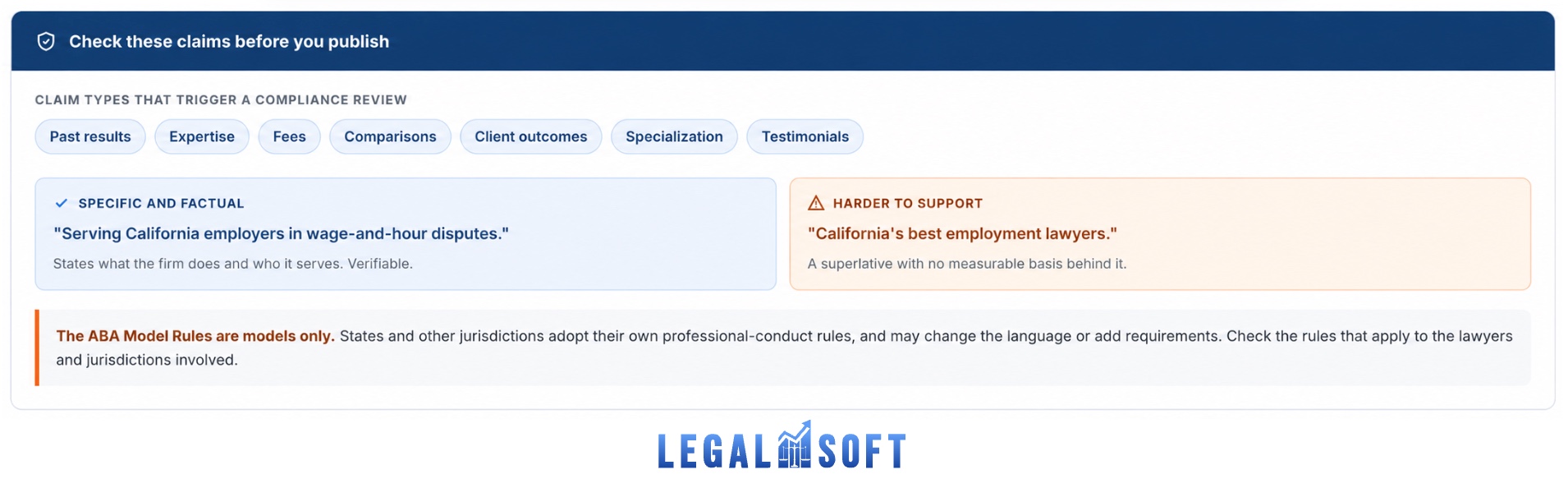
The ABA Model Rules are models. States and other jurisdictions adopt their own professional-conduct rules. They may change the language or add requirements. So before publishing a new brand message, testimonial, case result, comparison, or claim about specialization, check the rules that apply to the lawyers and jurisdictions involved.
This is one reason specific, factual positioning is often stronger than hype. "Serving California employers in wage-and-hour disputes" tells the reader something useful, while "California's best employment lawyers" creates a much harder claim to support.
Building Your Law Firm's Visual Identity
Once the strategy is clear, the visual work can begin. Your logo should work on a website header, phone screen, document, presentation, and business card. Simple designs are often easier to use across those formats, but there is no single logo style every law firm needs.
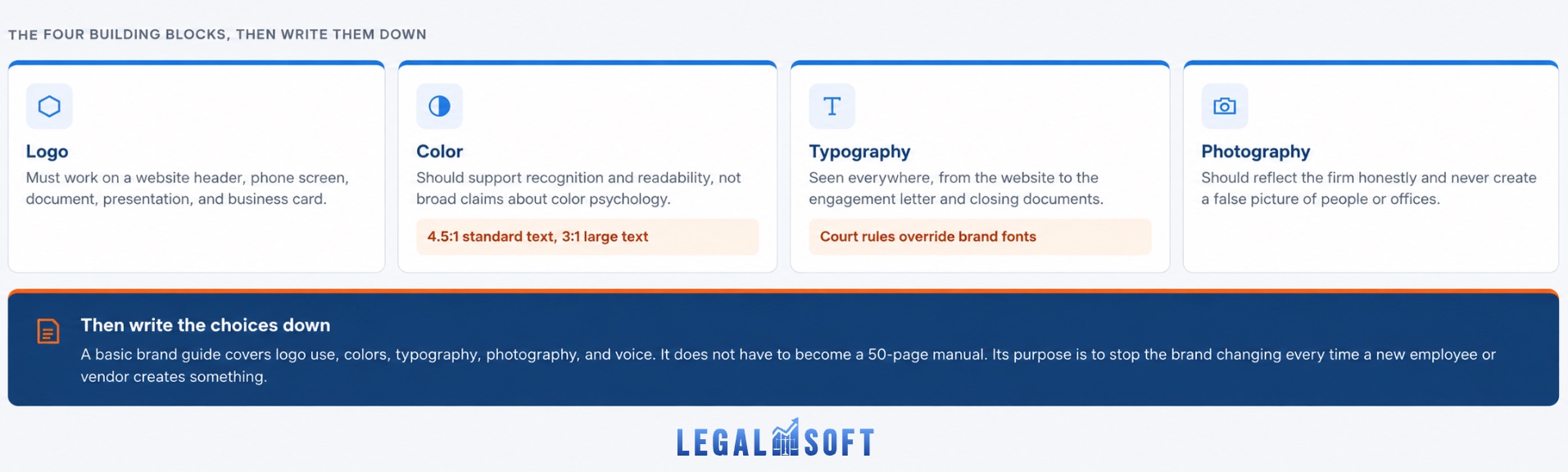
Color should support recognition and readability rather than rely on broad ideas about color psychology. Accessibility matters here. W3C guidance calls for a contrast ratio of at least 4.5:1 for standard text, with a 3:1 threshold for qualifying large text. That means a color combination that looks attractive but makes text hard to read is not doing its job.
Typography also matters because clients see it everywhere: the website, engagement letter, invoice, email, presentation, and closing documents. Court filings may have their own formatting rules, so a firm's brand font should never override a court's requirements. Choosing appropriate fonts for legal documents can support that part of the design process.
Photography should also reflect the firm honestly. Original photos can show clients the attorneys and staff they may actually meet. Stock images can still work. They should not create a false picture of the people, office, or services involved.
Finally, write the choices down. A basic brand guide can cover logo use, colors, typography, photography, and voice. It does not have to become a 50-page manual. Its purpose is to stop the brand from changing every time a new employee or vendor creates something.
Finding Your Law Firm's Voice
A law firm should sound like a law firm without sounding as if every sentence came from a contract. Start with a few words that describe the voice. A firm might choose clear, direct, and reassuring.
Then define what those words mean. "Clear" could mean explaining legal terms the first time they appear. "Direct" could mean answering the main question before giving background. "Reassuring" should not mean promising a result. It could mean telling clients what happens next and what they need to do. The best test is simple: could an intelligent person who does not work in law understand the message?
Voice also reaches beyond website copy. The person answering the phone is part of the brand. So is the legal assistant sending an update. So is the attorney explaining a bill. If your website sounds patient but the intake experience feels rushed, the client will trust the experience.
Personal Branding for Attorneys
In many firms, an attorney's personal reputation and the firm's brand grow together. Clients may search for a lawyer's name before they search for the firm. That makes attorney bios, professional profiles, speaking activity, and published content part of the larger brand.
A useful attorney bio should explain more than where the lawyer went to school. It can tell readers who the attorney serves, what kind of matters they handle, and what relevant experience they bring. It is worth learning how to write attorney bios that do that job properly.
Attorneys should still sound like themselves. Brand consistency does not mean giving every lawyer the same personality. Set the boundaries around accuracy, professionalism, visual standards, and core messaging, then leave room for each attorney's own voice.
What Good Law Firm Branding Looks Like
Good legal branding is usually less dramatic than people expect. A referral partner can explain what the firm does without looking at the website. An attorney bio supports the same position as the homepage. The intake specialist describes the firm's process in the same clear language the site uses.
Client emails sound professional without becoming difficult to understand. Documents look like they came from the same firm. Reviews mention some of the same qualities the firm claims to value. Most important, the client experience does not contradict the marketing. That consistency is more valuable than having the most unusual logo in the market.
Run a Brand Promise Audit
Before paying for a rebrand, check whether the firm already delivers the brand it wants.
This is a practical diagnostic tool, not a formal scoring model. The goal is to find gaps. If reviews regularly praise something that your website barely mentions, you may have found a stronger differentiator. If the site promises fast communication but reviews repeatedly mention slow responses, the problem may not be branding at all. It may be capacity.
Where Law Firm Brands Break Down
Law firm branding often fails when the promise and the operation stop matching.
These gaps can come from unclear processes, limited staffing, poor training, heavy caseloads, or unclear ownership. A new logo will not fix them.
Take intake as an example. If marketing works and the firm suddenly receives more calls, the existing team may struggle to answer every inquiry. A virtual receptionist or legal intake specialist may help the firm cover calls, collect information, schedule consultations, and follow a more consistent process.
The same issue can appear during active matters. If routine client updates are spread across several people with no clear owner, communication may become inconsistent. Clear client intake forms, defined responsibilities, and a practical law firm organizational structure can help turn the brand promise into a repeatable process. The basic rule is simple: do not promise a client experience the firm cannot support.
Where Your Law Firm Brand Shows Up Online
Your website is usually the main home of the brand, but it is not the only place people judge the firm. Search results, attorney profiles, Google Business Profile, reviews, social media, directories, media mentions, and third-party websites can all shape how the firm is understood.
Your website should make the core position clear quickly. Someone should be able to identify what the firm does, who it serves, and how to take the next step without searching through several pages. Strong law firm website features support branding when they make that journey easier.
Reviews deserve special attention because they show how clients describe the firm in their own words. Do not look only at the star rating. Read the language. Do clients keep mentioning communication? Speed? Organization? Clarity? Professionalism? Those patterns are useful brand research and should feed into your wider law firm reputation management work.
Social media and public relations can extend the brand further. The goal is not to repeat the same promotional statement everywhere. It is to build a consistent record of what the firm knows, does, and values.
How Do You Measure Law Firm Brand Awareness?
Brand awareness cannot be reduced to one number. The best approach is to track several signals and look for a pattern over time.
Branded Search
Google Search Console's branded and non-branded query filter is especially useful here. Google describes branded queries as searches that include the brand name, domain, brand-specific services, and common variations. The report can help measure brand awareness. It also separates people who already know the brand from more general search demand. Track your firm name as well as attorney names and common variations.
Referral Sources
Ask every new prospect how they first heard about the firm. Record the answer in a standard field instead of leaving it in free-form notes. Over time, this creates useful data about attorneys, former clients, search, reviews, social media, events, and other sources that introduce people to the firm.
Review Language
Look for repeated words and themes. If the firm's promise is clear communication and clients regularly mention clear communication, that is useful evidence that the message and the experience match. If reviews repeatedly describe a different strength, consider whether the brand should give that strength more attention.
Direct Traffic
Be careful with this metric. Google Analytics uses Direct when there is no clear referral source. That can include someone typing your URL. It can also happen when tracking information is missing, links lack proper campaign tags, redirects remove referral data, or other attribution problems occur. Direct traffic can support your analysis. It should not be treated as a clean measure of brand awareness.
Consultation-to-Client Conversion
Conversion rate can show whether qualified prospects are moving forward, but branding is only one influence. Case fit, lead source, fees, intake quality, follow-up, availability, and market conditions can all change conversion. Use the number with the rest of your brand data. Do not claim branding caused every increase or decrease. For most firms, looking at these measures quarterly is more useful than reacting to small changes every few weeks.
When Should a Law Firm Rebrand?
A law firm should consider a full rebrand when the business has changed enough that the current brand no longer represents it. A merger is one clear example. So is a major name change.
A rebrand may also make sense when the practice focus has shifted. A firm that once handled many types of matters may now receive most of its business from one practice area or industry. The target client may have changed too. Moving from individual consumers to business clients can require different messaging, content, and site structure.
Another warning sign is unclear positioning. If attorneys, employees, clients, and referral partners all give very different answers when asked what the firm is known for, the problem may be deeper than old photography.
But not every branding problem requires a full rebrand. Sometimes the firm only needs clearer website copy, updated attorney bios, new photography, better document templates, or a tighter visual system. Define the problem before deciding how large the project needs to be.
Frequently Asked Questions
What is law firm branding?
Law firm branding is the process of shaping how people understand and remember a legal practice. It includes positioning, messaging, visual identity, voice, and client experience. A logo is one part of the brand, not the entire brand.
What is the difference between law firm branding and marketing?
Branding defines how the firm wants to be understood. Marketing brings that message to an audience through channels such as search, content, advertising, referrals, social media, and events. Strong marketing works better when the underlying brand is already clear.
Do legal advertising rules apply to law firm branding?
Yes. Branding is a form of communication about the firm's legal services. Lawyers must consider applicable professional-conduct and advertising rules when making claims about services, experience, past results, specialization, comparisons, or other matters.
What are the main parts of a law firm brand?
There is no single required framework. This guide uses five practical parts: positioning, brand promise, visual identity, voice, and client experience.
Why is branding important for law firms?
Branding helps prospective clients and referral sources understand what a firm does, who it serves, and what they can expect. Clear branding can also make marketing more consistent and help a firm attract better-fit inquiries.
A Strong Brand Has to Work After the Client Calls
The strongest law firm brand is not the one with the best-looking logo. It is the one clients can understand and the firm can consistently deliver.
Start with clear positioning. Define what clients should expect. Build the visual identity and voice around those decisions. Then check the harder question: can the firm actually deliver what it now promises?
That question is where most of the work is. A firm may promise responsiveness and mean it, then watch response times slip when calls increase or caseloads grow. Nothing about the brand changed. The capacity behind it did. When that happens, a new logo or a rewritten homepage will not close the gap, because the gap is operational.
So before committing to a promise, check whether it holds on your busiest week rather than your quietest. If it does not, you have two honest options: narrow the promise to something you can keep, or add the capacity to keep the one you have. Virtual legal staff is one route to the second, particularly for intake and client communication, where the gap usually shows first.
Either way, the brand is only as good as the week it is tested in.